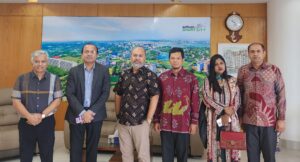
Four students from the Aquaculture Study Program, Faculty of Fisheries and Marine Sciences (FPK), Universitas Airlangga (UNAIR), participated in a Student Mobility Program at James Cook University (JCU), Singapore, from September 21–23, 2025. The delegation consisted of Alivia Angelin Elkos, Naomi Melly Maurin, Penta Aji Purnama, and Muthia Diffa Fauza, accompanied by two lecturers, Prof. Dr. Gunanti Mahasri, Ir., M.Si., and Dita Wisudyawati, S.Pi., M.Sc. This academic visit marked another milestone in FPK UNAIR’s commitment to global collaboration and innovation in aquaculture education and research.
Strengthening Academic Collaboration Through Student Mobility
The Student Mobility Program serves as a strategic initiative by FPK UNAIR to broaden students’ academic perspectives through international exposure and hands-on learning. During their visit to James Cook University (JCU) Singapore, the students engaged in a series of academic discussions, campus tours, and laboratory observations aimed at deepening their understanding of global aquaculture practices.
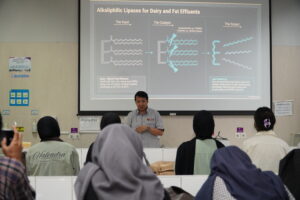
On the first day, participants arrived in Singapore and prepared for their scheduled academic visits. On the second day, they attended sessions at the Tropical Future Institute (TFI), a prominent research center at JCU Singapore. The visit was conducted on-site, allowing students to interact directly with researchers, faculty members, and laboratory staff. Activities included lectures and discussions covering inter-university collaboration, current global issues in fisheries, and knowledge-sharing sessions between lecturers and students.
Exploring Advanced Aquaculture Innovation at JCU Singapore
The field visit continued with an in-depth exploration of JCU’s state-of-the-art AquaHealth Laboratory, a premier facility supporting innovation in aquaculture health and sustainability. Students observed cutting-edge research equipment and were introduced to modern applications of biofilter technology used in barramundi (Lates calcarifer) culture ponds. They also studied Recirculating Aquaculture Systems (RAS) — an advanced and environmentally efficient system for sustainable fish farming.
Additionally, students learned about the use of limited land for aquaculture and the application of coral reef structures for ornamental aquariums, showcasing how space optimization and biodiversity preservation are integrated into JCU’s aquaculture research. Many of the technologies demonstrated at the Tropical Future Institute have not yet been widely applied in Indonesia, offering valuable insights and opportunities for future adaptation.
Through this experience, students realized the potential of adopting and developing similar innovations back home to enhance Indonesia’s aquaculture industry.
Gaining Insight and Building Commitment for Sustainable Aquaculture
The visit to James Cook University Singapore became a meaningful and transformative experience for the participants. The students expressed how the exposure to modern research infrastructure and advanced aquaculture techniques broadened their academic horizons. They also emphasized that the visit strengthened their commitment to advancing sustainable aquaculture development in Indonesia.
By engaging directly with global experts, students were inspired to integrate innovation, research, and collaboration into their academic journey. With the continuous support from FPK UNAIR, they are determined to contribute to national aquaculture excellence through the application of technology-driven and environmentally responsible practices.
This international program reflects FPK UNAIR’s vision to create globally competitive graduates equipped with practical experience, intercultural understanding, and a strong commitment to marine sustainability.