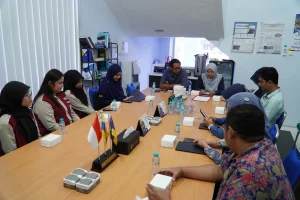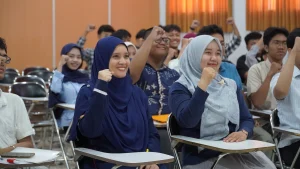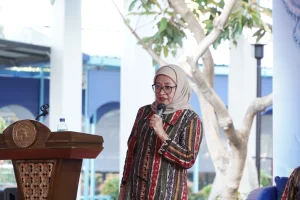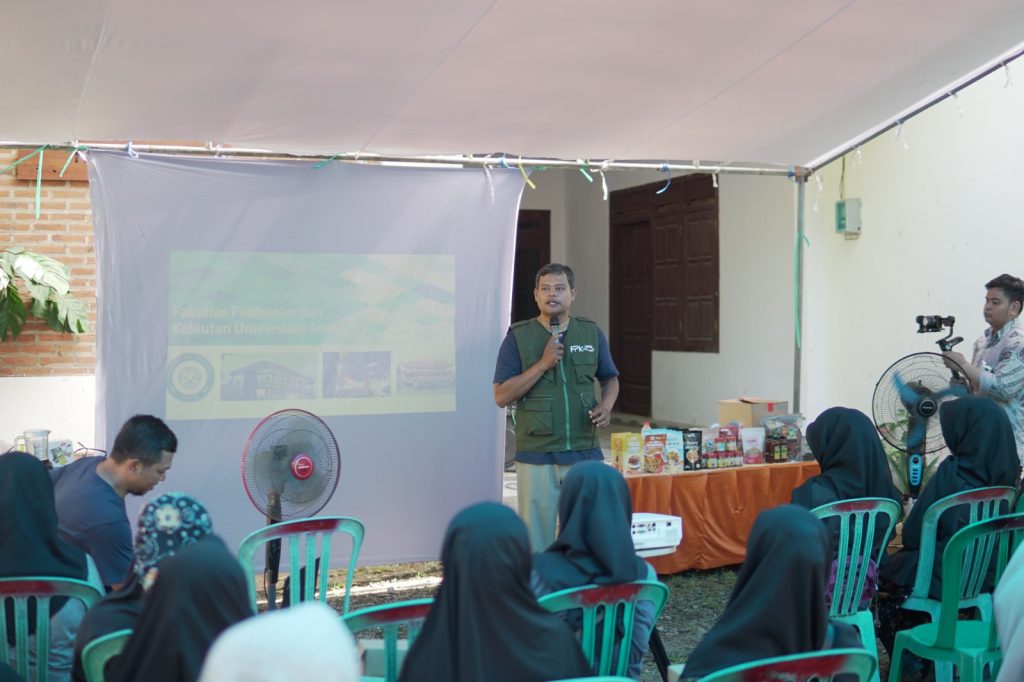
Banyuwangi is solidifying its position as a region with outstanding fishery potential. Demonstrating this strength, the Faculty of Fisheries and Marine Sciences (FPK), Universitas Airlangga (UNAIR), held a community service program titled “Training on Fish Stick Processing and Product Packaging to Support Fishery-Based Regional Development” in Wringinputih Village, Muncar, Banyuwangi.The activity was part of the Airlangga Community Development Hub (ACDH) 2025, a sustainable initiative that assists local communities in enhancing their marine-based economic resilience.The training adopted an interactive lecture format and gathered various local stakeholders — including youth organizations (karang taruna), tourism awareness groups (pokdarwis), and village residents — who showed great enthusiasm in participating. Participants gained not only technical knowledge but also strategic insights essential for sustaining local fishery-based businesses.
The first session was delivered by Heru Pramono, Ph.D., a lecturer from the Fishery Product Technology Study Program, Universitas Airlangga. He presented material on sanitation and hygiene principles in fish product processing, emphasizing the importance of maintaining cleanliness throughout all stages — from raw material selection and production to storage. “Wringinputih has tremendous fishery potential. However, without proper sanitation practices, the product’s value can drop significantly and deter consumers,” explained Heru. “That’s why this kind of training is crucial to help local MSMEs scale up and remain competitive.”
The next session, led by Dr. Eng. Sapto Andriyono from FPK UNAIR, focused on product packaging strategies and introduction to packaging materials.
He explained that packaging is more than just a cover — it represents the product’s identity, safeguards its quality, and extends its shelf life. “With the right packaging, fish stick products can compete effectively in modern markets,” said Sapto. He also introduced several types of food-grade plastics suitable for fish-based products and discussed labeling practices that comply with national regulations, highlighting the importance of product presentation in enhancing market appeal. Beyond improving technical understanding, the training also inspired the emergence of new fishery-based entrepreneurs in Wringinputih. As one of the major fish landing centers in Muncar, the village holds significant potential for strengthening the local economic chain through innovative processing and sustainable product development.
This initiative aligns with the United Nations Sustainable Development Goal (SDG) 14: Life Below Water, which emphasizes the sustainable use of marine resources. By improving community capacity in seafood processing, the program contributes to reducing fishery waste, increasing economic value, and promoting responsible marine resource utilization. The collaborative model of this activity reflects UNAIR’s vision of integrating academic expertise with community empowerment. The program demonstrates how knowledge transfer between universities and coastal communities can drive inclusive and sustainable development.
The participants’ enthusiasm signals a strong foundation for the program’s continuity. Villagers expressed hopes for regular follow-up training and business mentoring sessions in the future. With continued collaboration between academics and the local community, Wringinputih Village is poised to become a model of independent coastal development, capable of transforming marine resources into high-value, market-ready products. This initiative showcases UNAIR’s commitment to advancing community-based marine innovation while reinforcing Banyuwangi’s reputation as a leading fishery region in Indonesia.