Surabaya – The Faculty of Fisheries and Marine Sciences of Airlangga University (FPK UNAIR) continues to demonstrate its commitment to supporting the development of a sustainable fisheries sector through collaboration with strategic partners. This time, FPK UNAIR participated in the “Post-Harvest Handling Training for Seaweed for the WWF Indonesia Team and Agar Makmur Sentosa Cooperative” organized by WWF Indonesia in Kalialo Village, Sidoarjo Regency, on Monday, March 10, 2026.
The training activity is part of the project “Advancing Inclusive Blue Economies through Sustainable Aquaculture, Fisheries, and Habitat Protection in Indonesia,” an initiative aimed at promoting an inclusive and sustainable blue economy transformation across various coastal regions in Indonesia. Within this program, Sidoarjo Regency has been designated as one of the key intervention locations, particularly in the development of the seaweed aquaculture commodity Gracilaria verrucosa, which holds significant economic potential for local brackishwater pond farmers.
In this activity, Faculty of Fisheries and Marine Sciences, Airlangga University was represented by Eka Saputra, S.Pi., M.Si., accompanied by Fisheries Product Technology student Fahmi Bayhaqi from the 2022 cohort. The presence of both an academic representative and a student reflected the university’s tangible contribution to strengthening human resource capacity in the fisheries sector while reinforcing collaboration between academia, conservation organizations, local governments, and aquaculture communities.
The training session began at 14:00 WIB with participant registration followed by the official opening ceremony. The event was attended by the WWF Indonesia team, representatives of local government agencies, fisheries extension officers, and members of the Agar Makmur Sentosa (AMS) Cooperative who actively assist seaweed farmers in the Sidoarjo region. Their involvement highlights the importance of cross-sector collaboration in strengthening sustainable aquaculture development at the community level.
Following the opening session, participants received an introductory briefing emphasizing the importance of implementing proper post-harvest handling practices for seaweed commodities. Participants were also required to complete a pre-test to assess their baseline understanding of post-harvest management before proceeding to the technical training sessions.
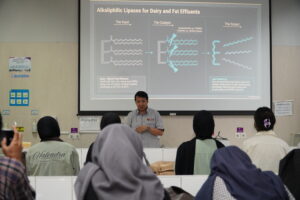
The core session of the training focused on good post-harvest handling practices for seaweed, including cleaning, drying, storage, and methods to reduce contaminants such as mud, sand, and other impurities that may affect product quality. During this session, participants not only received theoretical explanations but also conducted hands-on practice to better understand proper handling standards aligned with industry requirements.
The training also included an interactive discussion and question-and-answer session, providing participants with an opportunity to share field experiences and discuss various challenges encountered in seaweed post-harvest management. This discussion served as an important platform for knowledge exchange among practitioners, academics, and supporting institutions.
At the end of the program, participants completed a post-test to evaluate the improvement in their understanding after attending the entire training series. The agenda was then followed by preparations for a communal iftar gathering, strengthening relationships among participants and partners involved in the program.
Beyond technical aspects, the activity represents a broader effort to build a more sustainable fisheries system. By improving post-harvest quality, locally produced seaweed is expected to achieve higher product standards, increase its market value, and expand access to wider markets, including export opportunities.
These efforts are aligned with several United Nations Sustainable Development Goals (SDGs), particularly SDG 1 (No Poverty) and SDG 2 (Zero Hunger), through strengthening economic resilience and improving the welfare of coastal communities. Furthermore, better aquaculture practices and resource management also support SDG 14 (Life Below Water) and SDG 13 (Climate Action) by promoting sustainable coastal resource utilization.
The collaboration between WWF Indonesia, local governments, cooperatives, and universities such as FPK UNAIR also reflects the implementation of SDG 17 (Partnerships for the Goals) in strengthening multi-stakeholder partnerships to support sustainable development in the marine and fisheries sector. Readers can explore the continuation of this story in Part 2, which will discuss the objectives of the program, its benefits for coastal communities, and testimonials from training participants.