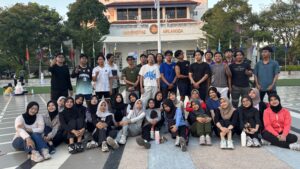
The Faculty of Fisheries and Marine Sciences (FPK) at Universitas Airlangga (UNAIR) successfully conducted its Student Mobility Program by sending four students to Singapore from September 21–23, 2025. This program was designed to provide students with international exposure, academic enrichment, and cross-cultural experience. One of the key highlights of the visit was an educational tour to the Lee Kong Chian Natural History Museum at the National University of Singapore (NUS), where participants explored diverse natural collections and learned about modern conservation techniques.
Expanding Global Perspective Through Student Mobility
In line with UNAIR’s mission to enhance academic competitiveness and global collaboration, the Faculty of Fisheries and Marine Sciences selected four outstanding students from the 2023 cohort to represent the faculty in Singapore. The selected participants were Alivia Angelin Elkos, Naomi Melly Maurin, Penta Aji Purnama, and Muthia Diffa Fauza.
They were accompanied by two faculty members, Prof. Dr. Gunanti Mahasri, Ir., M.Si., and Dita Wisudyawati, S.Pi., M.Sc., who provided academic guidance and supervision throughout the program. This short-term mobility initiative aimed to strengthen international collaboration, foster scientific curiosity, and encourage students to learn directly from global experts in fisheries, aquaculture, and natural sciences.
Educational Visit to Lee Kong Chian Natural History Museum
The visit to the Lee Kong Chian Natural History Museum took place on September 23, 2025, marking the final day of the student mobility program. During the visit, students had the opportunity to explore the museum’s extensive collections of fossils, animal specimens, and preserved biological samples. They were guided by Dr. Heok Hui Tan, a renowned researcher and curator, who provided detailed explanations about the museum’s exhibits and ongoing conservation projects.
Dr. Tan introduced the students to both wet and dry specimen preparation rooms, explaining how anatomical studies and specimen preservation contribute to biodiversity research. This interactive learning session offered valuable insights into the intersection of science, history, and environmental education. The hands-on experience not only deepened students’ understanding of natural history but also inspired them to integrate sustainability principles into their future research in aquaculture and marine science.
Inspiration and Reflection from the Singapore Experience
The FPK UNAIR delegation described the visit as an enriching and memorable learning experience. The museum’s modern layout and innovative exhibition design made the learning process engaging and dynamic, allowing students to connect theoretical knowledge with real-world applications.
Through this experience, participants gained a deeper appreciation for the global context of aquaculture and marine biodiversity conservation. They expressed renewed motivation to pursue research excellence and contribute to advancing Indonesia’s fisheries sector.
According to the delegation, the student mobility program reinforced UNAIR’s commitment to international exposure and academic excellence, preparing students to become globally minded professionals in the field of fisheries and marine sciences.