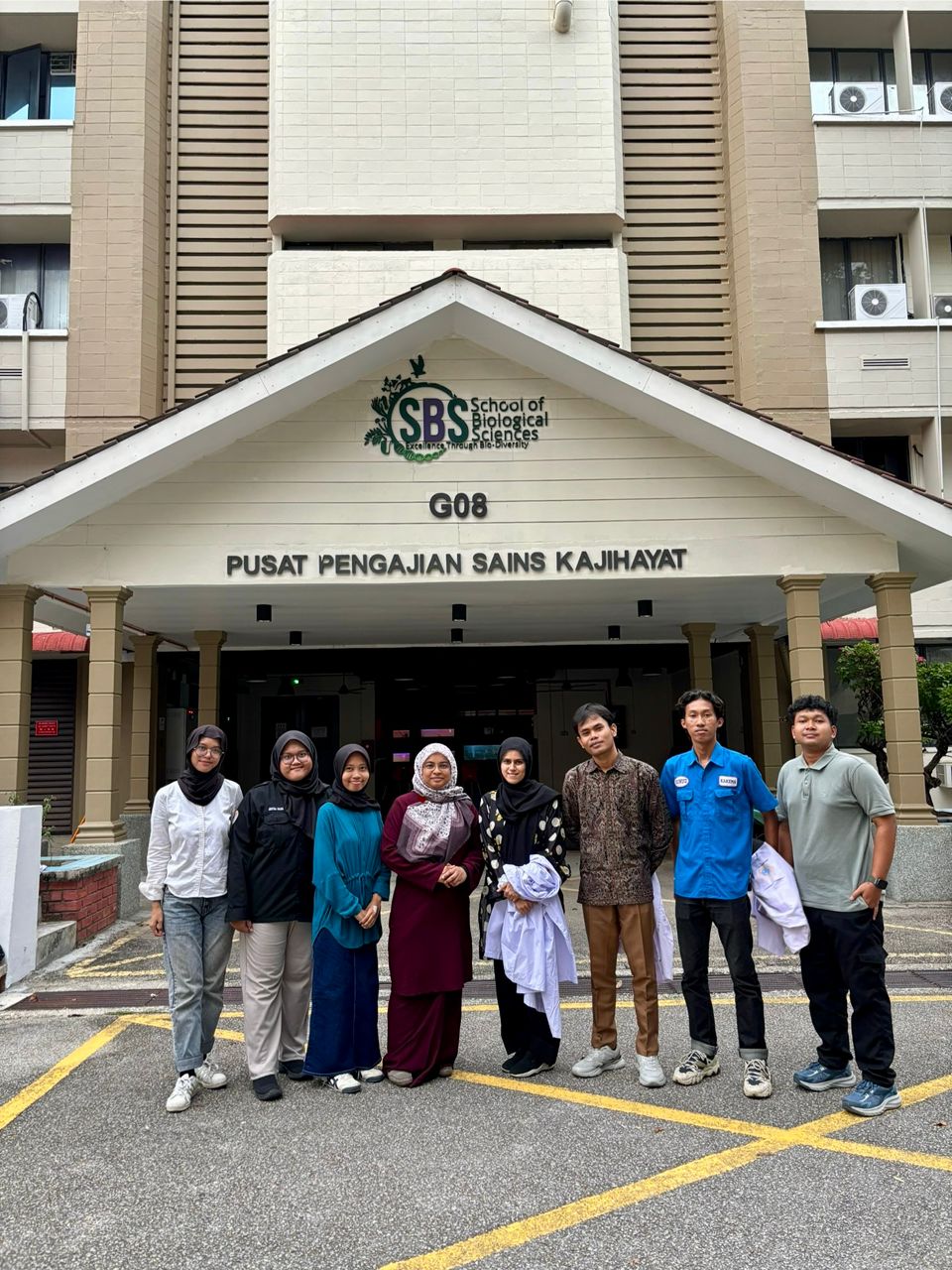
Six students from the Faculty of Fisheries and Marine Sciences, Universitas Airlangga — Nadhira Hasna Rashida, Eristha Salma Ramadhina, Darunna’im Fithri, Maulidi Arrohman, Iskandar Suhud, and Achmad Saif Alif Amrullah — have successfully completed their Internship Field Practice (PKL) program at Universiti Sains Malaysia (USM), Penang, Malaysia. The one-month internship, held from September 1 to September 28, 2025, provided the students with valuable international exposure and hands-on experience in modern aquaculture and fish feed formulation technology. The program was part of UNAIR’s commitment to enhancing student competence through global collaboration in research and innovation in sustainable aquaculture.
Throughout the program, participants engaged in a series of intensive laboratory activities at the Fish Nutrition Laboratory and Fish House, USM. They learned to formulate and produce various types of fish feed, including additive-enriched and control feeds. The process began with preparing additive materials—cutting, washing, drying them at 60°C for 2–3 days, and grinding them into powder. The additives were then incorporated into feed according to nutritional requirements, mixed thoroughly until homogeneous, and kneaded with water before being shaped using a pelletizer machine. The pellets were subsequently oven-dried again at 60°C for 24 hours to achieve optimal texture and shelf stability. In addition to experimental feed, the students also produced control feed to scientifically compare growth and health outcomes, ensuring research accuracy and reproducibility. They were further introduced to coated and incorporated feed preparation, where bioactive substances such as probiotics, enzymes, or immunostimulants were integrated to enhance fish growth efficiency and immune response. This direct practice deepened their understanding of sustainable feed formulation and its role in advancing eco-friendly aquaculture practices.
The students also participated in proximate feed analysis at the School of Biological Sciences, USM, focusing on determining crude fat content using chloroform solvent and measuring moisture levels with the Precisa HA6C instrument. These analyses were conducted under the supervision of doctoral students and in collaboration with peers from Universiti Sains Islam Malaysia (USIM). The use of advanced laboratory instruments and analytical techniques provided the participants with new insights and professional experience different from what they typically encountered at UNAIR. This international laboratory setting strengthened their technical skills, scientific rigor, and familiarity with global research standards in fisheries science.
In the field of fish biotechnology, the students gained experience in histopathological sampling techniques by extracting liver and muscle tissues from catfish (Clarias sp.) using a section set. The procedure was carried out systematically and hygienically, beginning with fish anesthesia to minimize stress, followed by careful dissection using sterilized tools. Liver samples were fixed in 10% formalin, while dorsal muscle tissues were collected for microscopic observation after histological staining. Through these sessions, students enhanced their precision and understanding of biological sampling procedures that align with international laboratory standards.
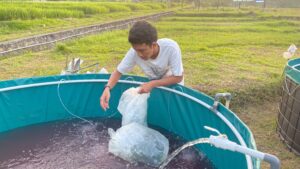
Beyond laboratory activities, the students also conducted weekly catfish sampling to monitor growth performance, assess health conditions, and record average body weight as supporting data for feed trials. This activity took place at USM’s indoor aquaculture system and pond facilities, which are equipped with controlled water quality and temperature management systems to optimize production efficiency. To complement their laboratory learning, the students joined a field trip to aquaculture sites in Teluk Bahang and Rimba Forest. These visits allowed them to explore traditional pond management for catfish, tilapia, and pangasius, gaining a comprehensive understanding of Malaysia’s extensive aquaculture practices and sustainable management approaches. The field experience also served as an opportunity to strengthen teamwork and cultural adaptability.
Throughout the one-month internship, the participants not only advanced their technical expertise in fish nutrition, feed formulation, and sustainable aquaculture but also improved their communication, cross-cultural adaptation, and confidence in using English in professional contexts. The exposure to USM’s academic environment and research culture equipped them with valuable competencies to face global challenges in the fisheries sector that demand innovation, precision, and environmental responsibility. The program concluded with a documentation session and reflective discussion, capturing the enthusiasm and collaborative spirit of all participants. This internship stands as a testament to the strong partnership between Universitas Airlangga and Universiti Sains Malaysia in cultivating globally minded aquaculture professionals dedicated to advancing fish feed technology and sustainable aquaculture for the future.