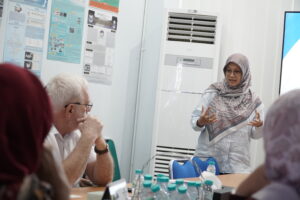
Latihan Keterampilan Manajemen Mahasiswa Tingkat Dasar (LKMM-TD) 2026 of the Faculty of Fisheries and Marine Sciences (FPK), Universitas Airlangga, once again presented a series of learning sessions designed to strengthen students’ organizational competencies. One of the key topics delivered on the first day was Organizational Fundamentals, presented by Terry Previo Avianto, M.Si. The session provided participants with a comprehensive understanding of organizational concepts, organizing processes, organizational structures, and the evolution of organizational theories relevant to student organizations and leadership development.
Held at Building C of FPK UNAIR, the session introduced participants to the fundamental role of organizations as structured groups of individuals working collaboratively toward shared goals. Beyond highlighting the importance of human resources, the speaker emphasized that organizational success depends on effective task allocation, communication, coordination, and interpersonal relationships among members. Through this discussion, students were encouraged to recognize that a well-managed organization requires both capable individuals and a systematic organizational framework.
Understanding the Importance of Organizing in Organizational Management
During the presentation, Terry Previo Avianto explained that one of the core functions of management is organizing, a process that involves arranging resources and activities to ensure organizational objectives are achieved effectively and efficiently. Organizing enables members to understand their responsibilities, roles, and contributions within the organization, thereby creating a clear direction for collective action.
The session highlighted the organizing process proposed by Ernest Dale, which includes identifying necessary tasks, assigning responsibilities to individuals or groups, grouping related activities into work units, establishing coordination mechanisms, and conducting monitoring and reorganization when needed. These stages allow organizations to operate systematically while remaining adaptable to changing circumstances and emerging challenges.
In addition, participants learned about the various functions of organizing within an organization. These functions include clarifying work expectations, preventing overlapping responsibilities, defining workflow processes, establishing communication channels, and creating effective coordination systems. Through proper organizing practices, organizations can improve efficiency while ensuring that every member understands their role in achieving common goals.
A major topic discussed during the session was the concept of the Four Building Blocks of Organizing, which consists of division of work, departmentalization, hierarchy, and coordination. According to Terry, these four elements form the foundation of an effective organization by ensuring that tasks are distributed appropriately, relationships among units are clearly defined, and activities are coordinated toward organizational objectives. Understanding these principles is particularly important for students who will later serve as organizational leaders, committee members, and project coordinators within campus organizations.
The discussion further emphasized that organizing is not merely about assigning tasks but also about creating a system that enables collaboration and accountability. By understanding organizing principles, students gain practical insights into how organizational effectiveness can be achieved through structured management practices and clear organizational arrangements.
Coordination and Organizational Structure as Keys to Effectiveness
The material then focused on coordination, one of the most critical elements in organizational management. Terry explained that coordination refers to the arrangement of collaborative relationships aimed at achieving unity of action in pursuing organizational goals. The level of coordination required depends on the nature of the work being performed and the relationships among organizational units. As interdependence among units increases, so does the need for effective communication and coordination mechanisms.
To provide a deeper understanding, participants were introduced to the three forms of organizational interdependence proposed by James D. Thompson: pooled interdependence, sequential interdependence, and reciprocal interdependence. These concepts illustrate how different organizational units rely on one another in varying ways, requiring distinct coordination approaches to maintain overall effectiveness and productivity.
The session also explored the concept of organizational structure, which was defined as the arrangement of functions and working relationships that represent the entirety of organizational activities. Organizational structures demonstrate how different functions and activities are connected and coordinated to support the achievement of shared goals. A clear organizational structure enables organizations to establish authority, define responsibilities, and facilitate decision-making processes.
To broaden participants’ perspectives, Terry introduced several forms of organizational structures, including line organizations, staff or functional organizations, line-and-staff organizations, and committee-based organizations. Each structure possesses unique characteristics and patterns of interaction designed to accommodate specific organizational needs and objectives. Understanding these structural variations is essential for students who will engage in organizational management and committee work throughout their academic journey.
Furthermore, the discussion highlighted factors influencing organizational structure based on Alfred D. Chandler’s perspective. These factors include technology, human resources, and organizational size. The speaker explained that organizations must consider these elements when designing structures that support operational efficiency, effective communication, and informed decision-making. Through these insights, students gained a broader understanding of how organizational structures evolve to meet organizational demands and environmental changes.
Organizational Theory Development and Relevance for Student Organizations
The final section of the session examined the development of organizational theory, beginning with classical administrative theory pioneered by Henry Fayol and progressing toward modern organizational perspectives. Classical theories primarily emphasized efficiency, authority, and formal organizational arrangements, while modern theories view organizations as dynamic systems that continuously interact with their external environments.
According to Terry, modern organizational theory recognizes organizations as open systems that must adapt to social, technological, and environmental changes. This perspective is increasingly relevant for student organizations, which are expected to respond proactively to evolving student needs, institutional developments, and societal challenges. The ability to adapt and innovate has become a crucial factor in maintaining organizational relevance and effectiveness.
Participants were encouraged to understand that successful organizations are not solely defined by their structures or procedures but also by their capacity to learn, collaborate, and evolve. By integrating classical management principles with contemporary organizational approaches, student organizations can develop stronger governance systems and more sustainable programs that create meaningful impacts for their members and communities.
Through the Organizational Fundamentals session, LKMM-TD 2026 participants gained valuable insights into how organizations are established, managed, coordinated, and developed effectively. The knowledge acquired is expected to serve as a foundation for students in carrying out their future roles as professional, collaborative, and responsible organizational members and leaders. These competencies are essential not only for campus organizational activities but also for preparing students to contribute positively to society and their future professional careers.
The session aligns with Universitas Airlangga’s commitment to supporting the Sustainable Development Goals (SDGs), particularly SDG 4 (Quality Education) through the enhancement of students’ leadership, management, and organizational competencies. Furthermore, the emphasis on coordination, communication, and collaboration supports SDG 17 (Partnerships for the Goals) by fostering a cooperative culture that serves as a cornerstone for successful student initiatives and organizational development.
Author: Alejandro Ahmad Zuhayr
Editor: TPA