


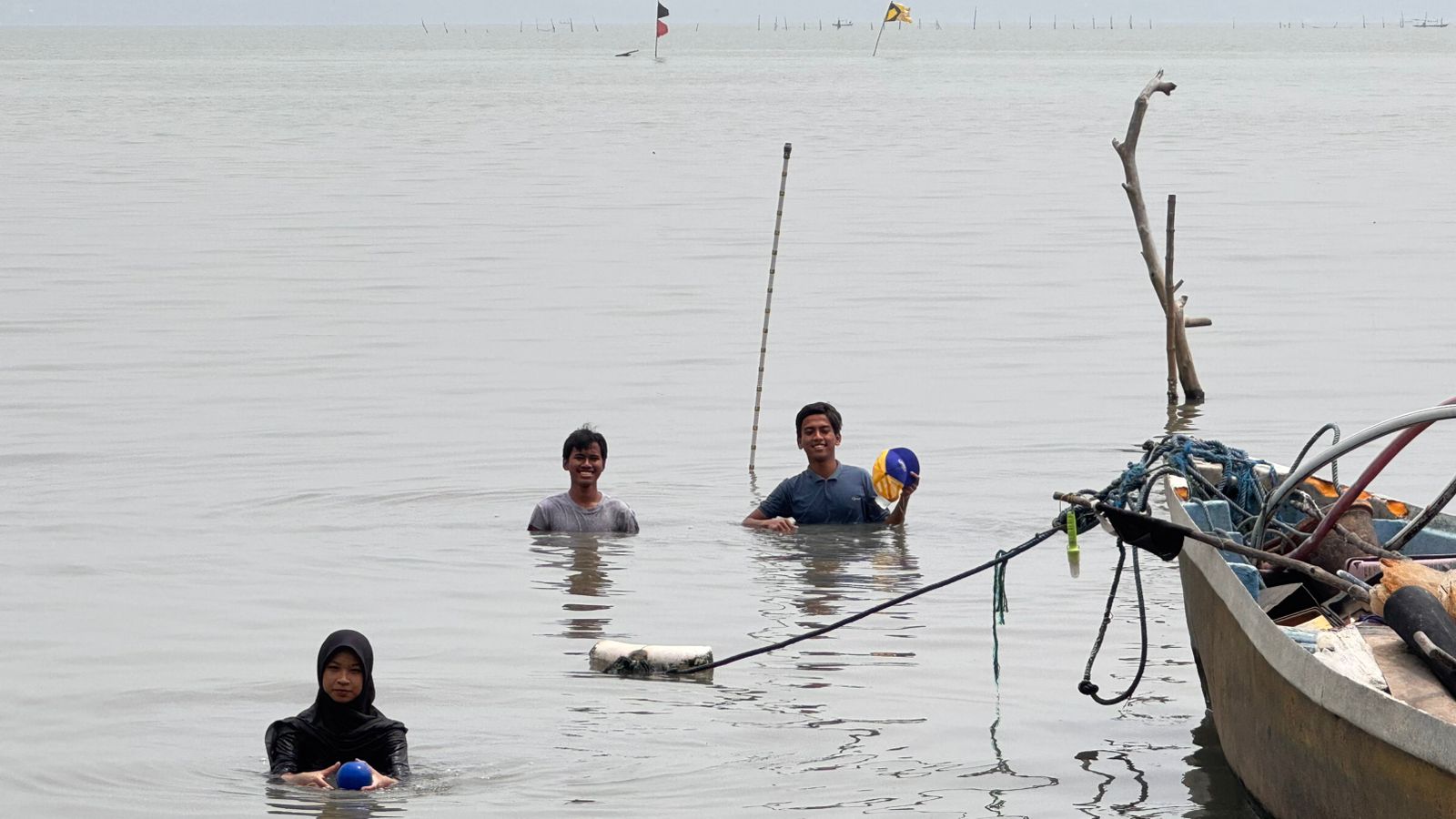
Surabaya — The field practicum simulation conducted by the 2024 cohort of the Marine Science and Technology (ITK) specialization under the Aquaculture Study Program at the Faculty of Fisheries and Marine, Universitas Airlangga (FPK UNAIR), serves not only as technical training for data collection but also as a collaborative learning platform that brings together students, teaching assistants, and lecturers in a direct field-based learning environment.
The activity, held at Kenjeran Watu-Watu Beach in Surabaya, was attended by lecturers from the Marine Science and Technology specialization, including Dr. Eng. Sapto Andriyono, S.Pi., M.T., Nina Nurmalia Dewi, S.Pi., M.Si., and Ayu Lana Nafisyah, S.Pi., M.Sc., Ph.D. Their presence provided academic supervision and ensured that the practicum activities were carried out in accordance with proper scientific methodology and academic standards. Through this supervision, students were able to gain practical insights while maintaining methodological accuracy during the field data collection process.
The practicum simulation was also supported by teaching assistants from senior cohorts who had previously undergone a rigorous selection process consisting of competency tests and interviews. Their role was to assist students in understanding the procedures for using oceanographic instruments, applying appropriate sampling techniques, and recording field data systematically. This mentoring approach helped ensure that participants were able to conduct each stage of the practicum safely, accurately, and effectively while reinforcing their understanding of scientific procedures used in marine research.
This peer-assisted learning model creates a collaborative and inclusive academic environment. Students do not only learn directly from lecturers but also benefit from the experiences and insights of senior students who have previously participated in similar field practicums. Such an approach strengthens academic collaboration within the university community and contributes to the improvement of higher education quality, particularly in preparing competent human resources in the marine and fisheries sector.
For the teaching assistants, the simulation also provided valuable opportunities to strengthen their academic capacity while gaining experience in facilitating field-based learning activities. Through their direct involvement in the practicum, assistants were able to revisit and deepen their understanding of sampling methods, oceanographic instrument operation, and scientific data recording procedures. Assisting junior students also helped them develop scientific communication skills in explaining theoretical concepts, practicum procedures, and preliminary interpretations of field data.
In addition to enhancing technical competencies, serving as teaching assistants also fostered leadership skills, teamwork coordination, and academic responsibility in ensuring that the practicum activities were conducted in a systematic and organized manner. Interaction with supervising lecturers and participating students created a constructive learning environment, allowing the assistants to act not only as facilitators but also as active contributors in the process of knowledge transfer within the academic community. This experience provides valuable preparation for senior students to further develop their scientific competence, professionalism, and readiness to contribute to the marine and fisheries sector.
Mohammad Salim Akbar, one of the practicum participants, shared that the field-based experience provided a deeper understanding compared to classroom learning. “Conducting the practicum directly in the field helped us better understand marine environmental conditions while also training our accuracy in collecting scientific data,” he explained.
Such experiences demonstrate that practice-based learning plays an important role in enhancing students’ readiness to conduct research and pursue professional careers in the marine and fisheries field. Through activities like this field practicum simulation, FPK UNAIR continues to strengthen its commitment to producing graduates who are not only academically competent but also adaptable to global environmental challenges and capable of contributing to sustainable marine resource management.


