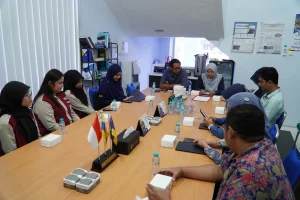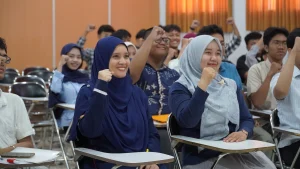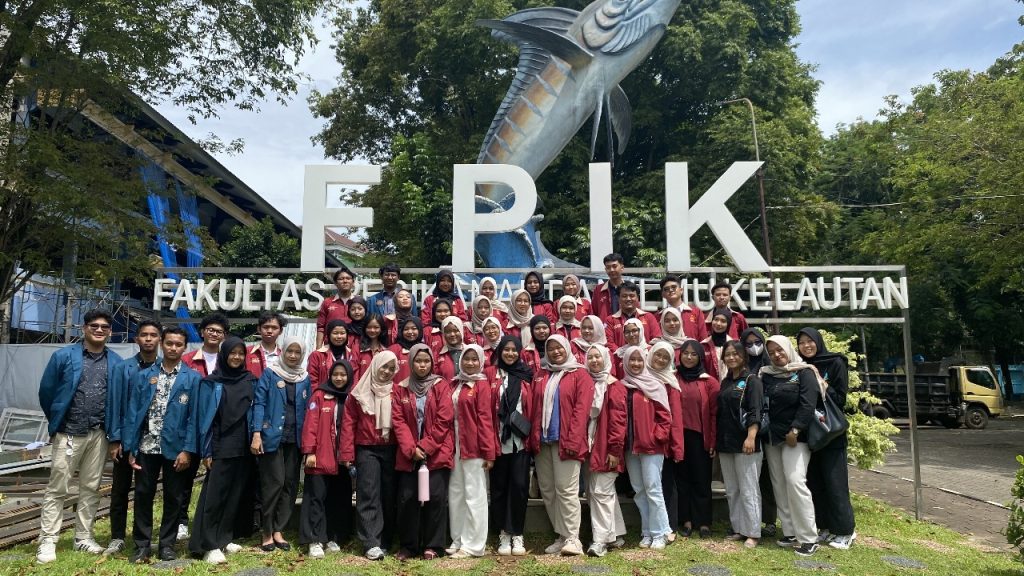
On Saturday, 8 November 2025, the Fisheries Processing Club (FPC) of the Faculty of Fisheries and Marine Sciences, Universitas Airlangga (FPK Unair), carried out a Comparative Study visit to the Fisheries Product Business Unit (UUHP) and Seaweed Student Organization of the Faculty of Fisheries and Marine Sciences, Universitas Diponegoro (FPIK UNDIP). The activity took place at Room C302, FPIK UNDIP, and served as a strategic platform to strengthen institutional networking and foster sustainable inter-organizational collaboration in fisheries processing and marine-based innovation. A total of 38 FPC members, 12 Seaweed members, and 6 UUHP representatives participated in the program, reflecting a strong commitment to academic exchange and organizational development between the two institutions.
The event began with opening remarks delivered by the respective chairpersons of FPC, UUHP, and Seaweed, emphasizing the importance of collaboration in advancing student capacity, innovation, and community engagement within the fisheries sector. Following the welcoming session, each organization presented its internal divisions and flagship work programs, highlighting their management systems, regeneration processes, and strategic priorities. One of the most notable presentations came from Seaweed, particularly from its Education and Training Division. The division implements a structured six-month training and capacity-building program (diklat) for prospective members. Participants undergoing Training Levels 1, 2, and 3 are designated as “Junior Staff,” while those who successfully complete the training sequence and formalize their commitment through a Memorandum of Understanding (MoU) are recognized as “Expert Staff.” This structured regeneration system demonstrates a strong commitment to professionalism, competency development, and long-term organizational sustainability. In addition, Seaweed shared its recent community service initiative conducted on 7 November 2025, in which members organized a public seminar on producing pempek—a traditional Indonesian fish-based product—using seaweed-derived carrageenan processed into flour as a functional additive. This product diversification approach not only enhances nutritional value and texture but also opens new opportunities for developing innovative fisheries-based food products aligned with sustainable marine resource utilization.
Meanwhile, the Fisheries Product Business Unit (UUHP) introduced its flagship product, Ekado, a protein-rich snack made from high-quality fish and shrimp meat. The product is processed using hygienic and modern techniques to ensure food safety, quality consistency, and nutritional benefits, positioning it as a healthy, high-protein, and low-fat alternative snack. The presentation highlighted how student-managed business units can integrate academic knowledge, applied research, and entrepreneurship within fisheries product development. Through this exposure, FPC members gained valuable insights into production management, product branding, and quality control systems that may serve as references for future innovation within FPK Unair. The session continued with an intensive discussion among the three organizations to explore potential collaborative research, joint community service programs, and shared product development initiatives. The dialogue also addressed strategies for strengthening student competencies in fisheries processing technology, expanding market-oriented innovation, and enhancing the impact of university-based organizations on coastal and marine communities. Overall, the Comparative Study was conducted smoothly and received highly positive responses from all participants. The outcomes of this activity are expected to provide strategic input for the future development of programs and capacity-building efforts within the Fisheries Processing Club, reinforcing FPK Unair’s commitment to academic excellence, applied research, and sustainable community engagement in the fisheries and marine sector.