

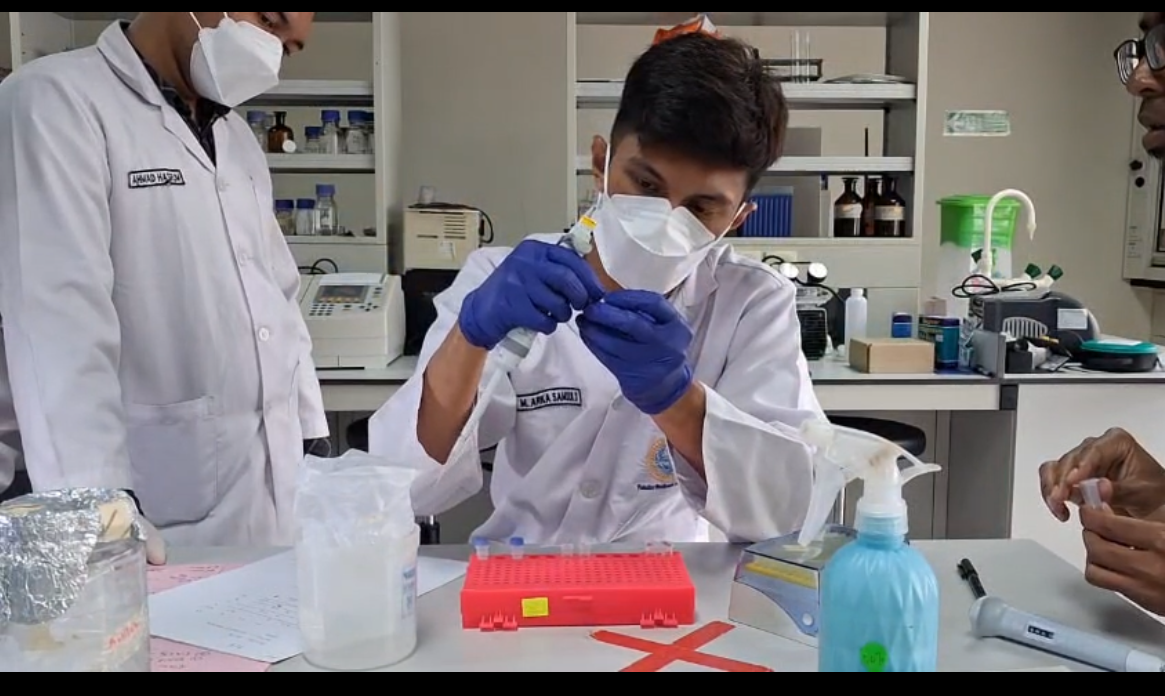
Six students from the 2022 cohort of the Aquaculture Study Program, Faculty of Fisheries and Marine Sciences (FPK), Universitas Airlangga (Unair), had the valuable opportunity to participate in an International Field Work Practice Program (PKL) at the Faculty of Science and Technology (FST), Universiti Kebangsaan Malaysia (UKM). Their main focus during this program was conducting PCR-based analysis of the tengas fish (Acrossocheilus hexagonolepis) — an experience that blended theory and hands-on laboratory practice in molecular biology. The internship provided profound academic exposure, enriching the students’ understanding of molecular techniques in fisheries biology, from species identification and genetic analysis to the conservation of ecologically significant local fish species.
The students began their academic journey at UKM with an intensive introduction to the fundamentals of Polymerase Chain Reaction (PCR) — a technique widely used in genetic research. They learned the basic principles, the role of Taq polymerase enzyme, and the key stages of PCR cycles, including denaturation, annealing, and elongation. These theoretical sessions were delivered clearly and systematically by UKM lecturers and PhD students, making complex molecular concepts easier to grasp. During the laboratory sessions, students directly experienced the challenge of performing precise molecular work — from extracting tengas fish DNA, preparing PCR mixtures, to observing DNA amplification results through gel electrophoresis. Each step demanded accuracy and patience, turning the lab into both an exciting and nerve-wracking learning space.
Beyond the technical aspects, the program highlighted the crucial role of molecular analysis in biodiversity conservation. The tengas fish, native to Southeast Asia, is increasingly at risk due to habitat degradation and overfishing. Through PCR-based genetic analysis, researchers can study the fish’s genetic variation in greater detail, providing essential data for sustainable management and conservation strategies. The students realized how molecular biology can serve as a bridge between laboratory science and environmental protection, demonstrating how technology contributes to preserving aquatic ecosystems.
Overall, the international internship at UKM not only strengthened the students’ technical expertise in molecular biology and genetics but also deepened their awareness of how science supports sustainable fisheries and aquatic resource conservation. The balance between theory, hands-on practice, and applied knowledge made this program an exemplary model for modern fisheries education. The collaboration between FPK Unair and UKM has proven how academic exchange can foster innovation and environmental responsibility among the next generation of scientists.


