

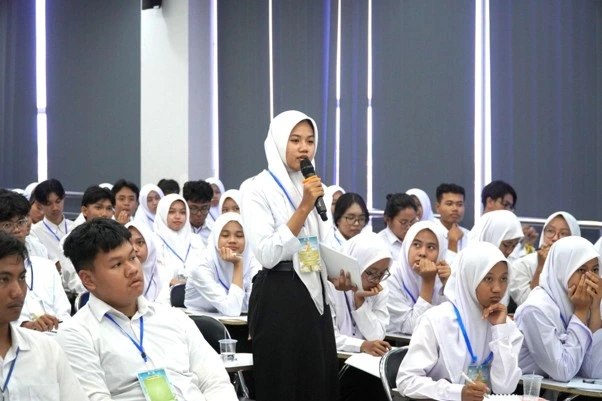
Surabaya – The first day of the Introduction to Campus Life for New Students (PKKMB) 2026 at the Faculty of Fisheries and Marine (FPK) Universitas Airlangga featured a session on Academic and Student Facilities on Wednesday (August 5, 2026). As part of the FPK Universitas Airlangga PKKMB 2026 program, the session introduced new students to the wide range of facilities available to support learning, research, and student activities throughout their academic journey.
The session was delivered by Luthfiana Aprilianita Sari, S.Pi., M.Si., Dr. Veryl Hasan, S.Pi., M.P., and Terry Previo Avianto, M.Si. Through their presentations, students were introduced to the faculty’s academic and supporting infrastructure, including lecture buildings, laboratories, study spaces, and student facilities. By understanding the purpose of each facility from the beginning of their studies, students are expected to maximize the use of these resources to enhance their academic performance, research activities, and personal development as members of the FPK Universitas Airlangga academic community.
Exploring Academic Buildings and Learning Spaces
During the session, new students were introduced to the three main buildings that serve as the center of academic activities at FPK Universitas Airlangga: Building A (Arwana), Building B (Bandeng), and Building C (Cakalang). Each building serves a distinct purpose, accommodating administrative offices, classrooms, laboratories, libraries, seminar rooms, and other educational facilities.
Building A functions as the center for academic and administrative services, housing the Academic and Student Affairs Office, Biotechnology Laboratory, Computer Laboratory, and reading room. Meanwhile, Building B serves primarily as the practical learning center, featuring laboratories such as the Anatomy and Aquaculture Laboratory, Natural Feed Laboratory, Nutrition Laboratory, Fish Processing Laboratory, and Analytical Chemistry Laboratory. Building C functions as the faculty’s main academic hub, accommodating the Dean’s Office, co-working space, lecturers’ offices, the Microbiology and Fish Disease Laboratory, lecture rooms, and administrative offices for the Master’s Program.
Laboratories Supporting Hands-on Learning
The session also introduced students to the diverse laboratories that play a vital role in practice-based education at FPK Universitas Airlangga. In addition to the Biotechnology, Computer, Anatomy and Aquaculture, Nutrition, Fish Processing, Analytical Chemistry, and Microbiology Laboratories, the faculty also operates an educational fish pond used for field-based learning and practical training.
These facilities are designed to provide students with comprehensive learning experiences by integrating theoretical knowledge with practical application, enabling them to develop competencies that meet the demands of fisheries and marine sciences.
Supporting Facilities for Student Development
Beyond academic infrastructure, FPK Universitas Airlangga also provides a variety of supporting facilities to enhance students’ daily campus life. These include Al Qalam Mosque, student organization offices (ORMAWA), reading rooms, campus-wide Wi-Fi zones, an aquaponics area, educational fish ponds, and electric bicycles that support mobility around the campus.
Through the Academic and Student Facilities session, new students gained a comprehensive understanding of the learning environment available at FPK Universitas Airlangga. The faculty’s well-developed infrastructure reflects its commitment to providing a comfortable, modern, and conducive educational environment that supports the development of highly qualified graduates in fisheries and marine sciences.
This commitment aligns with the Sustainable Development Goals (SDGs), particularly SDG 4 (Quality Education) through the provision of high-quality educational facilities, SDG 9 (Industry, Innovation and Infrastructure) through the continuous development of academic infrastructure, laboratories, and innovation spaces that support research and technological advancement, and SDG 3 (Good Health and Well-being) by fostering a safe, comfortable, and supportive campus environment for the well-being of the academic community.
Author: Fahmi Bayhaqi
Editor : Terry Previo Avianto


