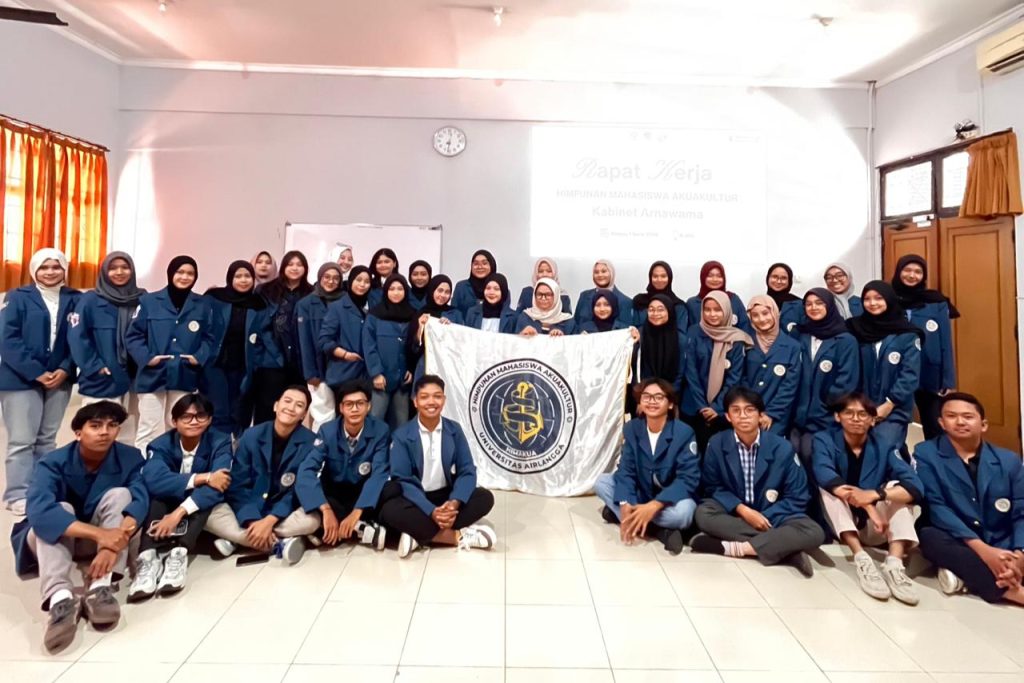
Himpunan Mahasiswa Akuakultur (HIMAKUA) of the Faculty of Fisheries and Marine Sciences Universitas Airlangga (FPK UNAIR) continues to strengthen its commitment to student development and the promotion of aquaculture through a series of innovative work programs in 2026. These initiatives were officially formulated during the HIMAKUA Work Meeting held on March 1, 2026, at Room B 3.04, FPK UNAIR. Under the leadership of the Arnawama Cabinet, the organization introduced a strategic agenda aimed at expanding academic engagement, enhancing student competencies, and increasing public awareness of aquaculture as an essential sector in sustainable food production and aquatic resource management.
During the meeting, HIMAKUA outlined several flagship programs designed to support both internal student development and broader community engagement. In addition to the community service program AQUABISA, which focuses on community empowerment in aquaculture practices, the organization proposed several initiatives aimed at strengthening student competencies and promoting aquaculture to wider audiences. These programs reflect HIMAKUA’s commitment to creating opportunities for students to develop leadership, communication, and professional skills while also strengthening the visibility of the Aquaculture Study Program within academic and public spheres. By integrating academic learning with outreach activities, HIMAKUA seeks to foster a generation of students who are capable of contributing to the sustainable development of fisheries and marine resources.
One of the highlighted initiatives is the TryOut Akbar and School Visit program, which aims to introduce aquaculture studies to high school students. Through this program, HIMAKUA members will visit schools to provide information about study opportunities, career prospects, and the role of fisheries and marine sciences in supporting national food security and sustainable aquatic resource management. The program serves as an educational outreach effort that encourages younger generations to explore the field of aquaculture as a promising academic and professional pathway. Furthermore, this initiative aligns with the Sustainable Development Goals (SDGs), particularly SDG 2 (Zero Hunger), by raising awareness of the fisheries sector’s role in strengthening global food security. It also supports SDG 14 (Life Below Water) through the introduction of sustainable aquatic resource management concepts to future generations.
In addition to public outreach, HIMAKUA also emphasizes the importance of strengthening students’ academic and professional competencies. One of the programs designed to address this goal is ELITE 4W (ELPT Intensive 4 Weeks), an intensive English training program for students of the Faculty of Fisheries and Marine Sciences. The program primarily targets first-year students and final-year students who have not yet achieved the required ELPT score. Through structured language training sessions, the program aims to improve students’ academic English proficiency, which is increasingly essential for accessing international academic resources, participating in global research collaborations, and preparing for future professional careers. By providing accessible language development opportunities, HIMAKUA hopes to support students in meeting academic requirements while also enhancing their competitiveness in the global academic environment.
Another major initiative proposed by HIMAKUA is Aquafest, a large-scale event featuring an aquascape competition. The event is designed as a creative platform for students and the wider community to express their interest and talent in aquascaping while simultaneously promoting awareness of aquatic ecosystems. Through Aquafest, participants are encouraged to explore the aesthetic and ecological value of aquatic environments while learning about the importance of maintaining balanced ecosystems. The program also supports SDG 13 (Climate Action) and SDG 14 (Life Below Water) by promoting environmental awareness and encouraging sustainable aquatic ecosystem management. In addition, the event aims to foster collaboration among students, communities, and external partners, reflecting the spirit of SDG 17 (Partnerships for the Goals) through multi-stakeholder engagement.
To further support students’ professional development, HIMAKUA also plans to organize an Entrepreneurship Information Seminar. This seminar will invite alumni from the Faculty of Fisheries and Marine Sciences who have built careers across various sectors, including government institutions, fisheries industries, and aquaculture businesses. Through this program, students will gain valuable insights into diverse career opportunities and professional pathways within the fisheries and marine sector. The event also aims to inspire students to explore entrepreneurial opportunities in aquaculture and related industries, encouraging innovation and self-development in the field.
In addition, HIMAKUA will also organize Natamandara, a welcoming event for new students of the Aquaculture Study Program. The activity will be designed with a more innovative and engaging concept to provide a positive first experience for incoming students. Beyond serving as an orientation program, Natamandara aims to introduce new students to the academic culture, organizational values, and collaborative environment within the Aquaculture Study Program at FPK UNAIR. Through this activity, HIMAKUA seeks to foster a sense of belonging and encourage new students to actively participate in both academic and organizational activities during their university journey.
Vice Chair of HIMAKUA 2026, Muhammad Ihsan Murtadho, expressed optimism that the various programs planned by the organization would create meaningful opportunities for student growth and community contribution. He emphasized that HIMAKUA aims to implement programs that not only support student development but also deliver tangible benefits for society and the environment.
Through the programs designed during the Work Meeting, HIMAKUA Arnawama Cabinet is optimistic about implementing innovative and collaborative initiatives that contribute to student development and the sustainable advancement of the aquaculture sector. By combining academic engagement, environmental awareness, and professional networking, HIMAKUA hopes to strengthen the role of students as active contributors to the future of sustainable fisheries and marine resource management.
Penulis : AAZ
Editor : AAZ