

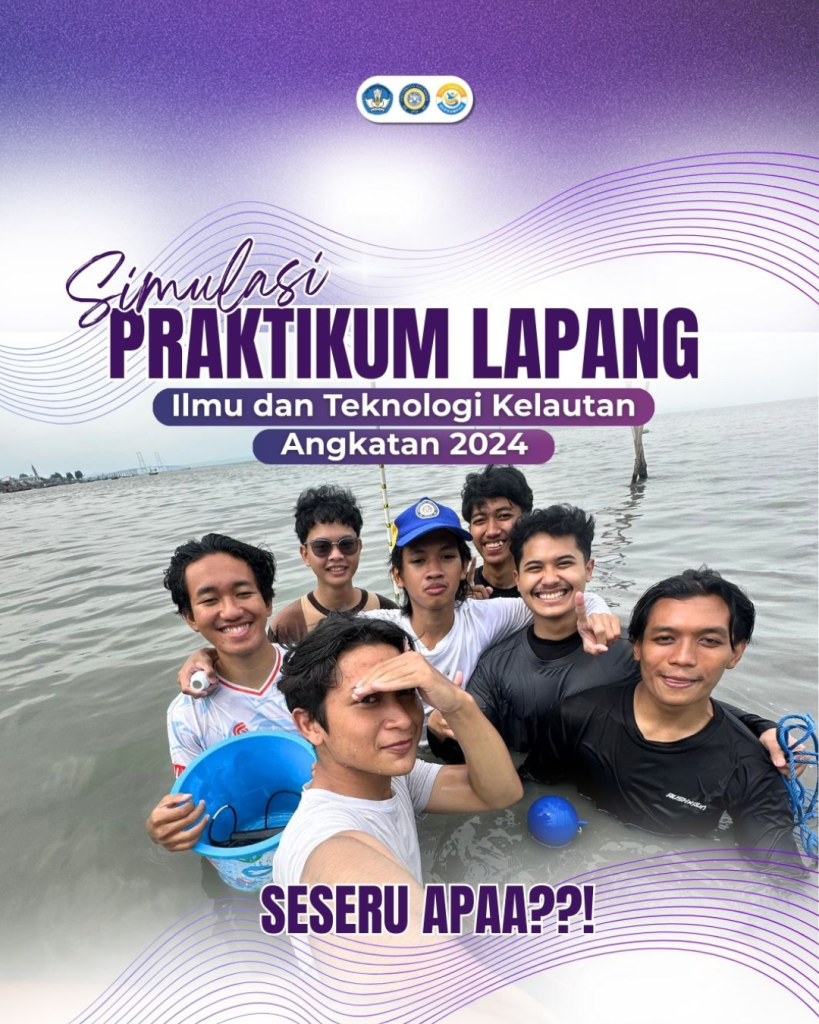
Surabaya — Students of the Aquaculture Study Program with a concentration in Marine Science and Technology (ITK), class of 2024, from the Faculty of Fisheries and Marine (FPK) Universitas Airlangga (UNAIR), conducted a field practicum simulation as an initial preparation before undertaking the official field practicum scheduled at the end of Semester 4. The activity took place on Tuesday, March 3, 2025, at the Kenjeran Watu-Watu Beach area in Surabaya, East Java, from 09.00 to 14.00 WIB.
The field practicum simulation serves as an essential component of experiential learning that integrates classroom-based theoretical knowledge with direct practice in coastal environments. Through this activity, students not only gain academic understanding of oceanographic concepts but also develop practical skills in field data collection, which is a fundamental competency in marine science studies. The activity was designed to introduce students to real environmental conditions while training them to operate scientific instruments and conduct systematic observations in coastal ecosystems.
The simulation involved the integration of four major courses, namely Chemical Oceanography, Physical Oceanography, Geological Oceanography, and Tropical Marine Ecology. The practicum activities were organized into three sessions, each consisting of three student groups that alternated in conducting environmental observations and measurements of marine parameters. This integrated approach allows students to understand the interconnection between physical, chemical, geological, and biological aspects of marine ecosystems within a single field-based learning experience.
During the Physical Oceanography practicum, students measured several water parameters including current velocity, tidal height, water transparency, and Total Dissolved Solids (TDS). These measurements aim to provide an understanding of the physical dynamics of marine waters that influence the stability and functioning of coastal ecosystems. By directly observing these parameters in the field, students gain a clearer perspective on how oceanographic processes shape marine environmental conditions.
Meanwhile, in the Chemical Oceanography session, students analyzed water quality by measuring pH, salinity, Oxidation-Reduction Potential (ORP), Dissolved Oxygen (DO), and nutrient concentrations such as nitrate, nitrite, ammonia, and phosphate. These parameters serve as key indicators in assessing the health of marine environments as well as the productivity of aquatic ecosystems. Understanding water quality conditions is crucial for marine resource management and environmental monitoring.
The practicum also included sediment pH measurement as part of the Geological Oceanography course, providing insights into the characteristics of seabed substrates. In the Tropical Marine Ecology session, students conducted identification of benthic organisms and plankton observations as part of biodiversity studies in coastal ecosystems. Through these integrated observations, students were able to explore the biological components that play vital roles in maintaining ecological balance in marine environments.
Through this simulation, students gained various benefits ranging from improved technical skills to a deeper understanding of marine environmental conditions. The in situ experience allows students to connect theoretical data with real natural phenomena, strengthening their ability to interpret water quality conditions and the dynamics of coastal ecosystems. Such understanding forms a fundamental basis for sustainable fisheries resource management while also providing insights into environmental changes influenced by climate dynamics in coastal areas.
In a broader context, enhancing students’ competencies in marine science is expected to contribute to the development of coastal communities and encourage more sustainable and equitable marine resource management. By combining theoretical learning with direct field experience, the Faculty of Fisheries and Marine UNAIR continues to support the development of future marine scientists capable of addressing environmental challenges and contributing to sustainable ocean management.
The implementation of this field practicum simulation also reflects the commitment of FPK UNAIR to support the Sustainable Development Goals (SDGs), particularly SDG 14 (Life Below Water), through strengthening the capacity of young generations in maintaining marine ecosystem sustainability. Understanding water quality and biodiversity provides an essential foundation for sustainable marine resource management.
In addition, the activity contributes to SDG 13 (Climate Action) by equipping students with the ability to understand environmental parameter changes related to coastal climate dynamics. Such knowledge is expected to encourage the development of science-based solutions to address future marine environmental challenges.
Farrel Bhanu Mahardika, Coordinator of Practicum Assistants, stated that the simulation was designed as an initial technical preparation stage for students before facing more complex field conditions.
“This simulation serves as an early preparation so that students are more ready to conduct data collection and operate scientific instruments during the actual field practicum,” he explained.
The activity also represents the implementation of collaborative learning among students, practicum assistants, and supervising lecturers as part of the higher education ecosystem that supports SDG 17 (Partnerships for the Goals). Through this early experience, students are expected to understand the importance of accurate field data in supporting marine research, fisheries resource management, and marine-based food security.


