The Faculty of Fisheries and Marine Sciences, Universitas Airlangga (FPK UNAIR), continues to strengthen its global academic engagement through an international guest lecture featuring Dr. Jose Domingos on 30 April 2026. The session highlighted the application of genomic selection in barramundi (Lates calcarifer) breeding to enhance disease resistance, reinforcing FPK UNAIR’s commitment to research-based learning and global collaboration in aquaculture science.
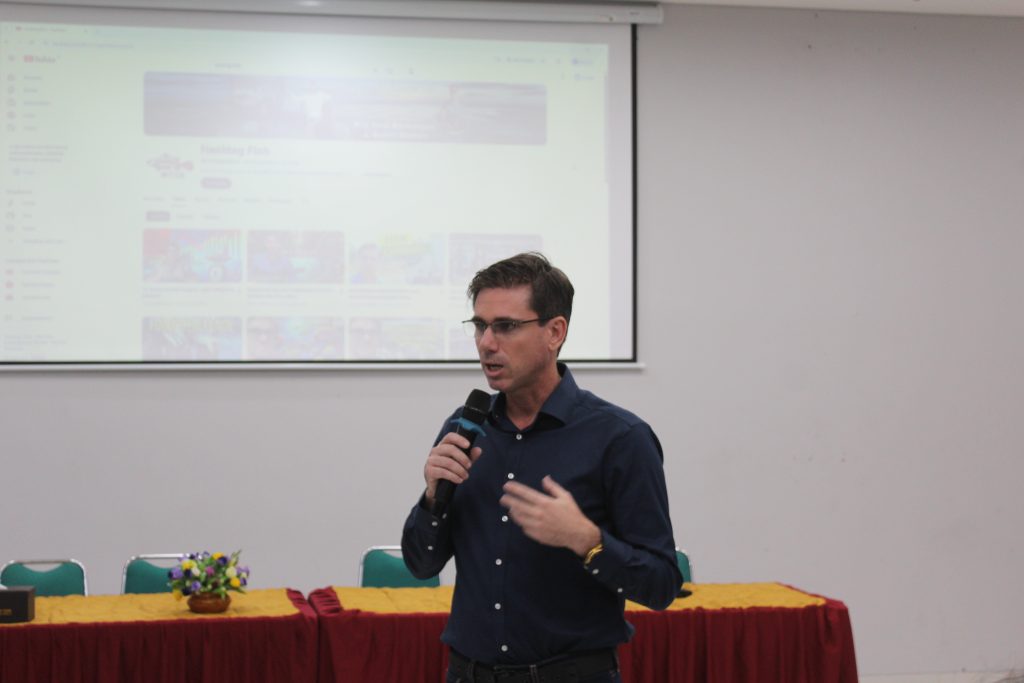
The guest lecture was held at Building C of FPK UNAIR during the Basic Aquaculture (DDA) Class B session, accompanied by Dita Wisudyawati, S.Pi., M.Sc. The event welcomed undergraduate students from the Aquaculture Study Program alongside faculty members, reflecting an inclusive academic atmosphere that encourages knowledge exchange across levels. Dr. Jose Domingos, a professor at James Cook University, Australia, attended as a Visiting Professor under the Academic Fellow Program. His presence marked a strategic step in FPK UNAIR’s internationalization agenda, aimed at integrating global research expertise into the faculty’s curriculum. From the outset, participants demonstrated strong engagement, particularly during the interactive discussion segment that addressed contemporary challenges in tropical aquaculture industries worldwide. Questions from students focused on the practical application of genomic tools in commercial hatcheries, the economic feasibility of advanced breeding technologies, and strategies to combat emerging fish diseases in marine aquaculture systems.
In his presentation, Dr. Domingos elaborated on genomic selection as an innovative approach within modern fish breeding programs, particularly for barramundi (Lates calcarifer), a commercially valuable species in the Indo-Pacific region. He emphasized efforts to improve resistance against Scale Drop Disease Virus (SDDV), one of the most significant viral threats affecting marine finfish aquaculture. By utilizing genetic markers and genome-wide analysis, breeders can identify superior broodstock with higher precision, accelerating the development of disease-resistant populations. This approach not only enhances survival rates and production performance but also contributes to more sustainable aquaculture practices by reducing dependency on chemical treatments and minimizing economic losses. Through detailed case studies and data-driven explanations, Dr. Domingos illustrated how genomic selection bridges fundamental genetic research with industry-scale implementation, offering students direct insight into how molecular science translates into tangible aquaculture innovation.

Beyond the technical discussion, the lecture underscored the importance of international academic partnerships in advancing research capacity and educational quality. The primary objective of the event was to broaden students’ understanding of cutting-edge developments in aquaculture genetics while fostering cross-border scientific dialogue. The participation of Dr. Domingos as part of the Academic Fellow Program reflects FPK UNAIR’s dedication to establishing strategic partnerships with leading global institutions. This initiative aligns with the Sustainable Development Goals (SDGs), particularly Goal 17: Partnerships for the Goals, which highlights the importance of global cooperation in strengthening research, innovation, and higher education capacity. The direct interaction with an international professor provided students with exposure to global research standards, methodologies, and professional networks, thereby enriching their academic experience and encouraging future collaboration opportunities such as joint research projects, academic exchanges, and co-authored publications.
One of the participants, Yaya, a 2025 cohort student of the Aquaculture Study Program, expressed that attending a lecture delivered by an international professor was a memorable academic experience. She noted that the session helped her better understand how genetic research is applied in real-world aquaculture industries at a global scale. According to her, the systematic and research-based presentation inspired greater interest in pursuing studies in genetics and fish breeding. Through the organization of this guest lecture, FPK UNAIR reaffirms its role as a higher education institution committed to fostering global engagement and delivering internationally benchmarked learning experiences. The collaboration established through this program is expected to serve as a strategic foundation for strengthening FPK UNAIR’s presence in the global academic landscape while promoting collaborative and sustainable aquaculture innovation.