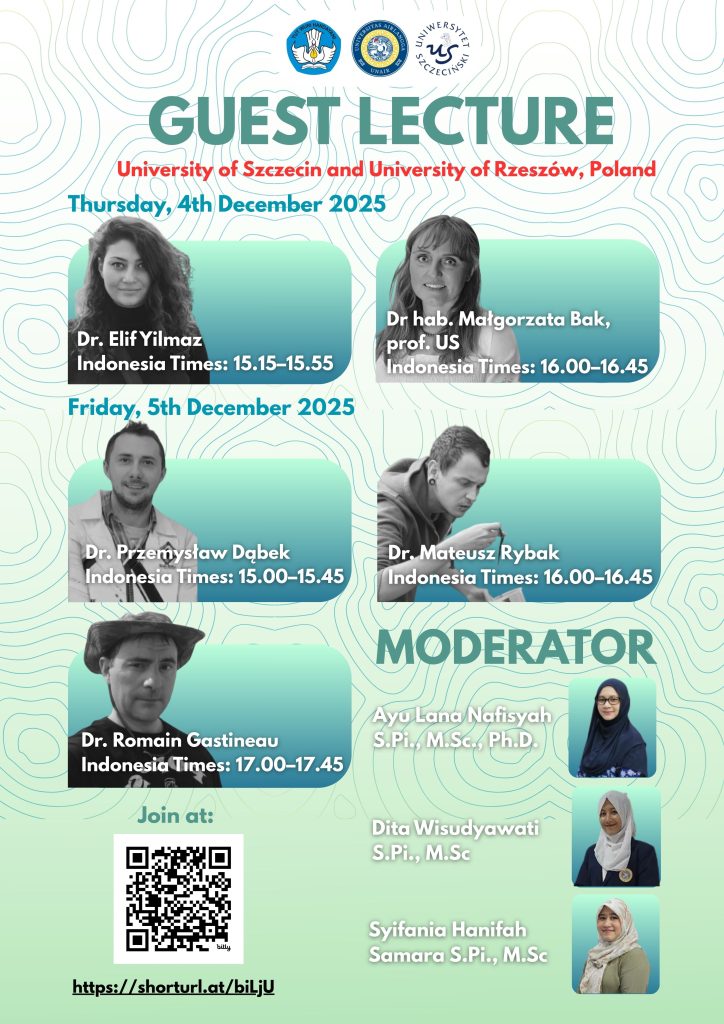
The Department of Aquaculture, Faculty of Fisheries and Marine Sciences, Universitas Airlangga (UNAIR), successfully organized an International Guest Lecture on 4–5 December 2025, bringing together five distinguished researchers from University of Szczecin and University of Rzeszów, Poland. The academic forum highlighted cutting-edge studies on diatoms and microalgae, particularly in the fields of environmental biomonitoring and microalgae genomics. The event was attended by 150 third-semester students, reflecting UNAIR’s commitment to strengthening global academic engagement and providing international exposure for its undergraduate community.
Held online via Zoom to ensure broad accessibility, the Guest Lecture formed part of the Department’s strategic initiative to internationalize its academic programs and expand collaborative research networks. On the first day, Dr. Elif Yilmaz from the University of Szczecin opened the session by presenting her research on volcanic lake formation, geochemical characteristics, and the survival of life in extreme environments. Her presentation explored how chemical dynamics and environmental stressors shape biological communities in unique aquatic systems, offering valuable insights for students studying aquatic ecology and environmental management. The session was moderated by Dr. Ayulana, who facilitated a dynamic discussion between participants and the speaker.
The program continued with Dr. hab. Małgorzata Bak, prof. US, also from the University of Szczecin, who delivered a lecture on diatom-based biomonitoring. Her presentation emphasized the role of diatoms as reliable bioindicators for assessing water quality and ecosystem health. By demonstrating how species composition and abundance patterns can reflect environmental changes, she provided practical perspectives highly relevant to aquaculture sustainability and aquatic resource management. The discussion session enabled students to explore methodological approaches in sampling, identification, and ecological interpretation, reinforcing their understanding of applied environmental science.
On the second day, three additional experts expanded the scope of discussion. Dr. Przemysław Dąbek from the University of Szczecin addressed diatom systematics based on phylogenetic analysis, highlighting the importance of molecular tools in refining taxonomic classification and evolutionary relationships. His session, moderated by Madam Dita, connected classical morphology-based taxonomy with modern genomic techniques. Subsequently, Dr. Mateusz Rybak from the University of Rzeszów presented his research on diatoms found in mineral water sources, explaining their ecological specificity and potential applications in environmental assessment. The lecture series concluded with Dr. Romain Gastineau from the University of Szczecin, who discussed genomic investigations of microalgae, including advances in sequencing technologies and their implications for biotechnology and environmental monitoring. Moderated by Madam Syifania, the closing session underscored how genomic research can enhance understanding of microalgal diversity and adaptive mechanisms.
Each presentation was allocated 30 minutes, followed by a 10–15-minute interactive question-and-answer session, allowing participants to engage directly with the researchers. Through this structured academic exchange, students gained exposure to international research standards, contemporary methodologies, and cross-disciplinary approaches in aquatic science. The International Guest Lecture not only strengthened institutional collaboration between UNAIR and Polish universities but also reinforced the Faculty’s mission to cultivate globally competent graduates equipped with scientific insight and environmental responsibility. By integrating research-based learning into the undergraduate curriculum, the Department of Aquaculture continues to advance innovation, sustainability, and international partnership in fisheries and marine sciences.