

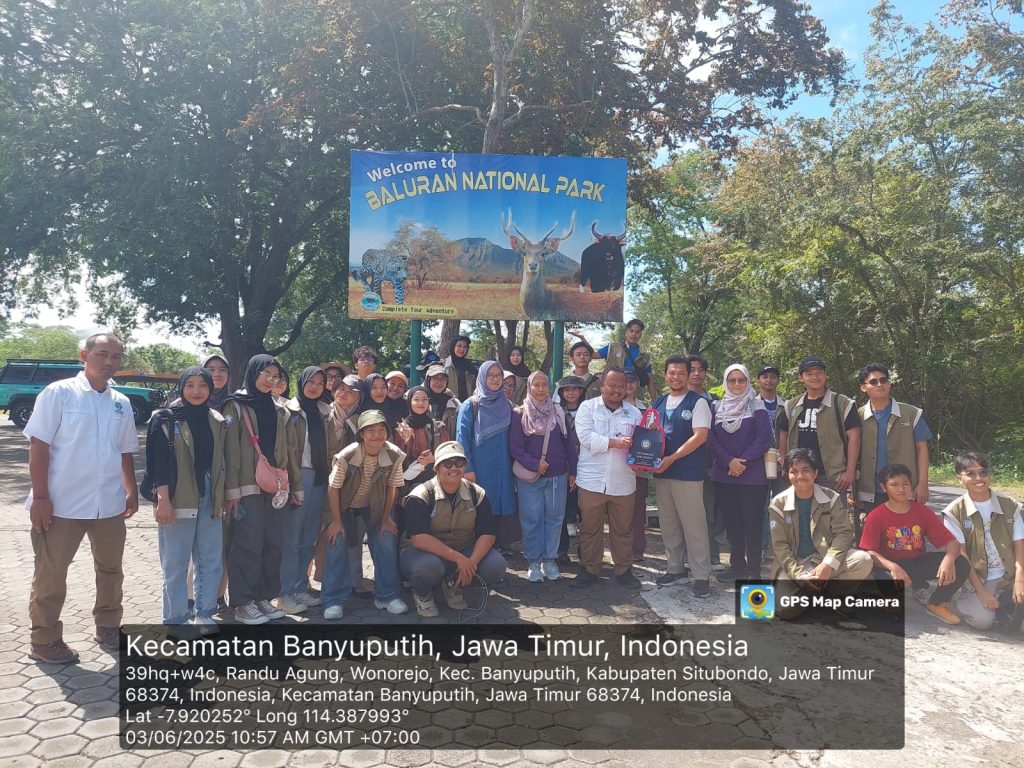
Situbondo – June 3, 2025 – A total of 29 Aquaculture students with a focus on Marine Science and Technology from the Faculty of Fisheries and Marine Science (FPK), Universitas Airlangga (UNAIR), participated in a hands-on field practicum at Baluran National Park, East Java. This immersive activity is part of their coursework in Conservation, Bioprospecting, and Fisheries and Marine Resource Survey and Mapping.
Under the guidance of five supervising lecturers and coordinated by Dr. Eng. Sapto Andriyono, S.Pi., M.T., the practicum took place on Tuesday, June 3, 2025. The day began with an orientation session provided by the Baluran National Park authority, where students gained in-depth insights into the management of conservation areas, challenges in biodiversity preservation, and policies for coastal and marine protection. The session also highlighted the importance of sustainable practices for protecting ecosystems and fostering environmental responsibility among future marine scientists.
Following the observation and scientific discussion sessions, the students actively participated in a beach clean-up along Bama Beach. Together with their lecturers, they collected plastic waste and other inorganic debris, demonstrating their commitment to environmental stewardship. Gusti Putri, affectionately known as Giya, one of the participating students, shared, “This beach clean-up is our way of supporting Baluran National Park’s conservation efforts. We aim to leave a positive footprint while showing that protecting the ocean starts with small actions like not littering.”
The initiative received positive feedback from park officials, who praised the students’ proactive efforts in maintaining the cleanliness of the protected area. The field practicum not only enhanced the students’ understanding of marine and fisheries resources but also nurtured a sense of conservation ethics and environmental responsibility. Activities like this embody Universitas Airlangga’s commitment to educating a generation of young scholars who are environmentally conscious and ready to contribute to sustainable marine resource management.
By combining practical fieldwork with academic learning, UNAIR students experienced a unique opportunity to apply theoretical knowledge in real-world contexts. The practicum emphasized the role of community involvement in conservation, research skills in biodiversity assessment, and the importance of teamwork in achieving environmental goals. Such hands-on experiences are integral to developing competent, socially responsible graduates capable of advancing marine science and sustainable fisheries practices in Indonesia and beyond.


