

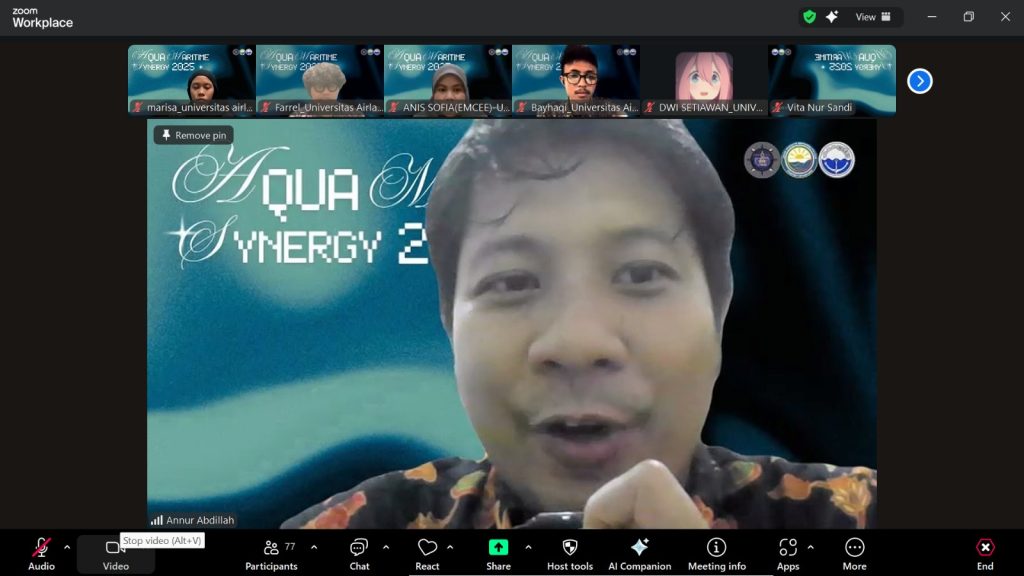
AQUAMARITIME SYNERGY 2025 marked a significant milestone in strengthening international maritime collaboration between Indonesian and Malaysian student organizations. Initiated as a strategic partnership among the Student Executive Board of the Faculty of Fisheries and Marine Sciences, Universitas Airlangga (BEM FPK UNAIR), Maritime Expert Generation (MAX-G), and the Naval Club of Universiti Malaysia Terengganu (UMT), the program was conducted virtually on November 20, 2025. The event aimed to expand academic networks, enhance cross-border organizational understanding, and foster sustainable cooperation among maritime-focused student communities. Through structured discussions, institutional presentations, and interactive dialogue, AQUAMARITIME SYNERGY 2025 served as a dynamic platform for knowledge exchange and organizational development within the broader maritime academic landscape of Southeast Asia.
The event was officially organized by BEM FPK Universitas Airlangga in collaboration with MAX-G and Naval Club UMT as part of a shared commitment to advancing maritime education and leadership development. Conducted online to ensure broader participation and accessibility, the program brought together student leaders, organizational representatives, and academic advisors from both Indonesia and Malaysia. The initiative reflects the Faculty of Fisheries and Marine Sciences’ broader mission to strengthen international engagement, particularly in areas related to marine science, fisheries management, maritime sustainability, and student capacity building. The opening ceremony began with formal proceedings, including the national anthems of Indonesia and Malaysia, followed by institutional remarks that highlighted the strategic importance of regional academic cooperation. The structured agenda included opening remarks, leader vision statements, organizational profile presentations, a mini talk show session, interactive discussion, e-certificate distribution, documentation, and closing statements.
The first welcoming address was delivered by Mr. Hadi, S.Pi., M.Si., Ph.D., representing the Faculty of Fisheries and Marine Sciences, Universitas Airlangga. He emphasized the importance of international collaboration in broadening students’ academic perspectives and preparing them to address global maritime challenges. He highlighted that cross-border engagement not only strengthens institutional networks but also enriches student competencies in leadership, communication, and problem-solving within the marine and fisheries sector. The second address was delivered by Dr. Sayyid Zainal Abidin bin Syed Ahmad from Universiti Malaysia Terengganu, representing MAX-G. He underlined the strategic value of transnational cooperation in reinforcing academic networks and promoting knowledge-sharing among maritime scholars and student leaders. The third welcoming remark from a representative of Naval Club UMT reaffirmed the importance of regional synergy among maritime organizations and expressed hope for sustainable collaboration beyond this program.
Following the institutional remarks, the presidents of BEM FPK UNAIR, MAX-G, and Naval Club UMT each delivered leadership presentations outlining their organizational visions, missions, and strategic priorities. They introduced the scope of their activities, including student empowerment programs, maritime research initiatives, community engagement projects, and professional development opportunities. Each leader emphasized that AQUAMARITIME SYNERGY 2025 plays a crucial role in building long-term partnerships, sharing best practices, and cultivating a collaborative culture among maritime students across borders. The subsequent organizational presentation session provided detailed insights into each organization’s structure, flagship programs, and capacity-building strategies aimed at strengthening maritime competencies. The Mini Talk Show segment further explored practical topics such as member recruitment strategies, high-impact programs, operational challenges, and key considerations in designing innovative initiatives. The discussion was interactive and reflective, allowing participants to exchange perspectives and identify potential areas for joint activities, including academic forums, research collaboration, and community-based maritime projects. The event concluded with an open question-and-answer session that encouraged constructive dialogue on organizational development and collaborative opportunities, followed by the symbolic distribution of e-certificates, documentation, and closing remarks. Overall, AQUAMARITIME SYNERGY 2025 successfully strengthened maritime networks and opened broader avenues for Indonesia–Malaysia student collaboration in advancing sustainable marine and fisheries development.


