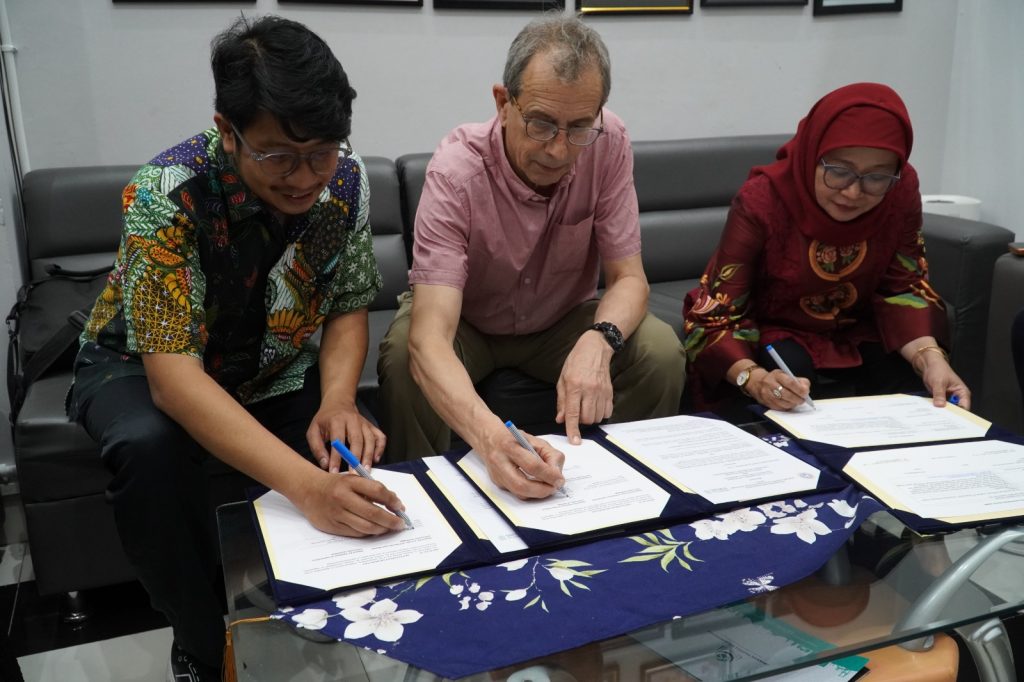
The Faculty of Fisheries and Marine Sciences, Universitas Airlangga (FPK UNAIR), officially signed an Implementation Agreement with the Institute of Aquaculture, University of Stirling, United Kingdom, on 22 April 2026 for the organization of the Asian Fish Welfare Network (AFWN). The signing marks a significant milestone in strengthening international collaboration in aquaculture, particularly in advancing and implementing fish welfare principles in Indonesia and across Asia. It also reaffirms FPK UNAIR’s strong commitment to sustainable aquaculture practices aligned with global standards.
The agreement was signed by Annur Ahadi Abdillah, S.Pi., M.Si., Ph.D., Vice Dean for Research, Innovation, and Community Development of FPK UNAIR, together with Professor David Little, Principal Investigator of the Asian Fish Welfare Network from the University of Stirling, and was acknowledged by the Dean of FPK UNAIR, Prof. Dr. Endang Dewi Masithah, Ir., MP. This strategic moment represents a concrete step in expanding global academic networks and reinforcing FPK UNAIR’s position as a higher education institution actively contributing to the transformation of Indonesia’s aquaculture sector. The collaboration demonstrates a shared vision to integrate scientific research, innovation, and community engagement in addressing contemporary challenges in fish farming.
Through this Implementation Agreement, both institutions clearly define their respective roles and responsibilities in delivering AFWN 2026. FPK UNAIR serves as the host institution, providing venue facilities, logistical coordination, and on-site organizational support to ensure the effective execution of the program. Meanwhile, the University of Stirling contributes financial support covering transportation and accommodation for participants, meals during the event, and the involvement of expert personnel and technical resources in program design and implementation. This complementary partnership model reflects a balanced and impact-oriented collaboration, combining local institutional capacity with international expertise.
The flagship program under this agreement is titled “Improving the Welfare of Farmed Animals for the Benefit of Indonesian Aquaculture: Good Welfare is Better Business.” The initiative emphasizes that the adoption of fish welfare principles is not merely an ethical obligation but also a strategic business approach capable of enhancing productivity, operational efficiency, and product quality. By integrating welfare-based management systems into aquaculture practices, the program aims to strengthen the competitiveness of Indonesia’s aquaculture industry in the global market. Activities under AFWN 2026 include workshops, capacity-building sessions, expert exchanges, and the development of sustainable aquaculture frameworks designed to bridge academic research with industry application and community empowerment.
This collaboration is highly relevant to several Sustainable Development Goals (SDGs). Increasing productivity and efficiency in aquaculture contributes to SDG 1 (No Poverty) by improving the economic resilience of fish farmers, and SDG 2 (Zero Hunger) by supporting food security through sustainable aquatic protein production. The promotion of environmentally responsible fish farming practices aligns with SDG 13 (Climate Action) and SDG 14 (Life Below Water), as it encourages responsible management of aquatic ecosystems and climate-conscious production systems. Furthermore, the cross-country partnership between FPK UNAIR and the Institute of Aquaculture, University of Stirling reflects the practical implementation of SDG 17 (Partnerships for the Goals), highlighting the importance of international academic cooperation in driving sectoral transformation.
The agreement is valid for one year from the date of signing and may be extended upon mutual consent. Looking ahead, the implementation of AFWN is expected not only to enhance the academic and research capacity of lecturers and students at FPK UNAIR but also to generate tangible benefits for the aquaculture industry and farming communities in Indonesia. As part of its internationalization strategy, FPK UNAIR continues to open avenues for global collaboration aligned with its vision of advancing fisheries and marine sciences through innovation and sustainability. This milestone further underscores FPK UNAIR’s role as a strategic partner in shaping a more resilient, inclusive, and internationally competitive future for Indonesian aquaculture.