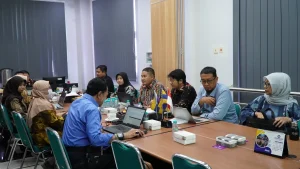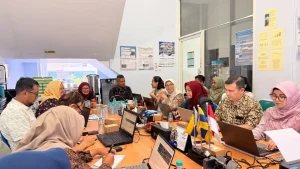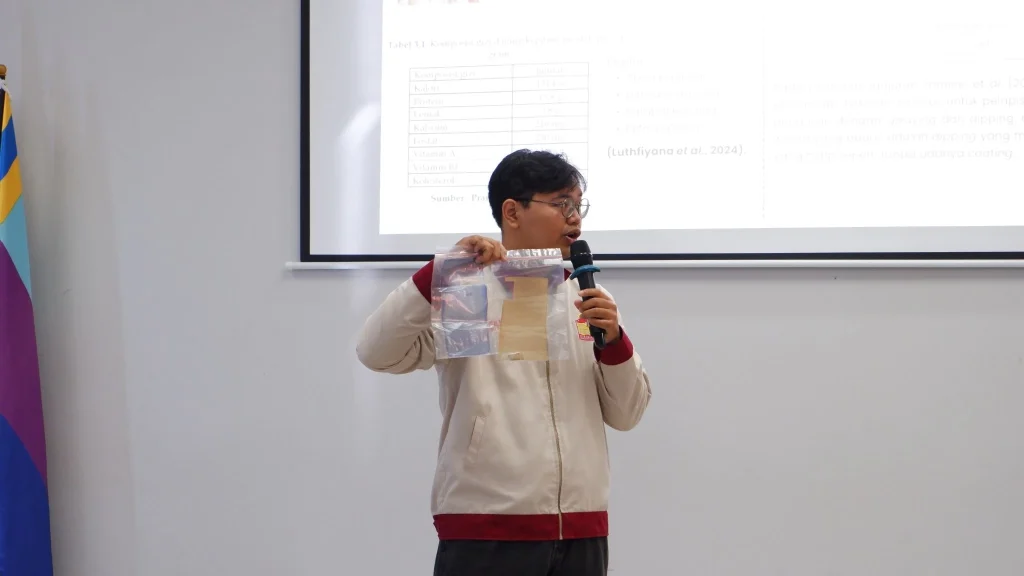
Surabaya – New students of the Fisheries Product Technology (THP) Study Program, Faculty of Fisheries and Marine (FPK), Universitas Airlangga (UNAIR), were introduced to one of the important areas of THP, namely fisheries product diversification. The introduction was delivered by members of the Fisheries Processing Club (FPC) as part of the 2026 Introduction to Campus Life for New Students (PKKMB).
Through the session, students were introduced to various possibilities for developing fishery resources into a wider range of processed products. Different types of fishery commodities were used as examples to demonstrate that fishery products do not have to remain as fresh food ingredients, but can be further developed into products with different forms and added value.
The FPC members explained that diversification is an interesting area within Fisheries Product Technology. With appropriate processing techniques, fishery raw materials can be transformed into various products that are more practical and appealing to consumers. During the session, shrimp received particular attention as one of the fishery commodities with considerable potential to be developed into a wide range of processed products.
The introduction also provided new students with an initial understanding of how the knowledge they will acquire can be applied to increase the added value of fishery commodities. For THP students, this process is not merely about creating new products, but also requires an understanding of raw material characteristics and the appropriate processing technologies.
The material on shrimp diversification subsequently served as an initial foundation before students took part in a practical session on shrimp product diversification in the following activities. Thus, students were not only introduced to the concept of diversification but would also have the opportunity to observe how a product idea can be transformed into an actual product through hands-on processing.
The transition from theoretical material to practice is part of a learning approach that connects knowledge with direct experience. Students can explore firsthand how raw material characteristics, processing techniques, and creativity can be combined to produce products with added value. This approach supports SDG 4 (Quality Education) through practical and experiential learning while introducing students to processing innovations related to SDG 9 (Industry, Innovation and Infrastructure).
For new students, the session with FPC offered an initial perspective on the broad opportunities available within the field of Fisheries Product Technology. From fishery raw materials to ready-to-consume products, students were introduced to the process of developing commodities into more diverse and value-added products. This understanding will then be brought to the practical session, where shrimp will serve as the main raw material for students to directly explore the diversification concept they have been introduced to.
Writer: Fahmi Bayhaqi
Editor : TPA