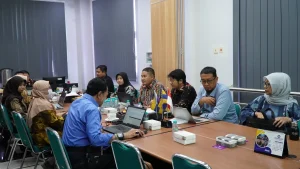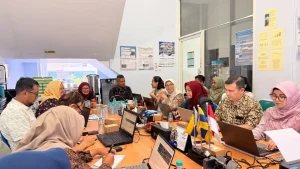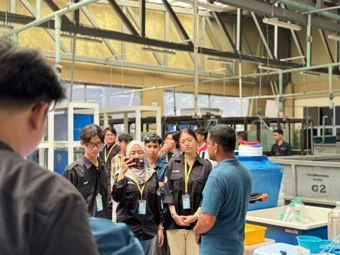
Surabaya – Six students from the Aquaculture Study Program, Faculty of Fisheries and Marine (FPK) Universitas Airlangga (UNAIR), expanded their academic experience through the Internship @ Universiti Malaysia Terengganu (UMT) program in Terengganu, Malaysia, from August 1–23, 2026. During the program, the students were directly involved in research on genetics and natural feed cultivation while gaining insights into fisheries and marine activities within the UMT environment.
The internship provided students with an opportunity to develop their research skills through hands-on experience outside the university campus. Throughout the program, students received guidance from UMT supervisors and assistant supervisors during various stages of their research. This guidance helped students understand research procedures while strengthening their independence and adaptability within an international academic environment.
In the field of genetics, the students collected samples from three fisheries commodities: tiger shrimp, vannamei shrimp, and mangrove crab. The samples were subsequently processed through extraction and bioinformatics analysis to study phylogeography, particularly the genetic differences of the same commodities from various regions across Southeast Asia. Through this research, students gained experience applying molecular approaches to understand genetic diversity and contribute to the development of knowledge in aquaculture.
Meanwhile, another research project focused on the utilization of microalgae monoculture as natural feed in the cultivation of Crassostrea iredalei oysters. The students studied oyster larval growth rates while also understanding the relationship between natural feed and the successful growth of cultured organisms. This experience broadened the students’ understanding of developing efficient and sustainable aquaculture technologies.
In addition to conducting research, the students participated in sampling activities at several locations, including the UMT hatchery, traditional markets, and Setiu Island. These activities provided experience in sample collection while introducing students to fisheries activities and field conditions in Malaysia. Through direct fieldwork, students were able to connect the knowledge acquired in the classroom with real-world conditions while developing accuracy and adaptability.
Akhsan, One of the participants considered the support provided by UMT an important part of creating a meaningful research experience.
“During the internship, the UMT supervisors and assistant supervisors were very helpful throughout every stage of the activities. They did not expect us to immediately do everything perfectly, but guided us in detail until we understood each process,” the participant said.
The research experience outside Indonesia also provided students with new perspectives on academia and fisheries.
“Terengganu is the right place to develop research experience. However, more importantly, it takes the courage to see the world beyond Indonesia because such experiences can broaden our perspectives and become something we will always remember,” the participant added.
Strengthening Skills through International Experience
Through the Internship @ UMT, students not only gained technical research skills but also developed independence, communication skills, and cross-cultural perspectives. The activity aligns with the Sustainable Development Goals (SDGs), particularly SDG 2 (Zero Hunger) through the development of aquaculture knowledge to support food availability, SDG 14 (Life Below Water) through increased understanding of aquatic resources, and SDG 17 (Partnerships for the Goals) through strengthening the academic partnership between FPK UNAIR and UMT.
The experience is expected to equip students to face academic and professional challenges while encouraging innovation in sustainable aquaculture development. Through international learning opportunities, FPK UNAIR continues to provide students with opportunities to expand their competencies and perspectives beyond the classroom.
Writer : Farrel Bhanu Mahardhika
Editor: Terry Previo Avianto