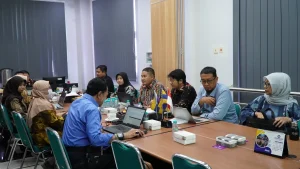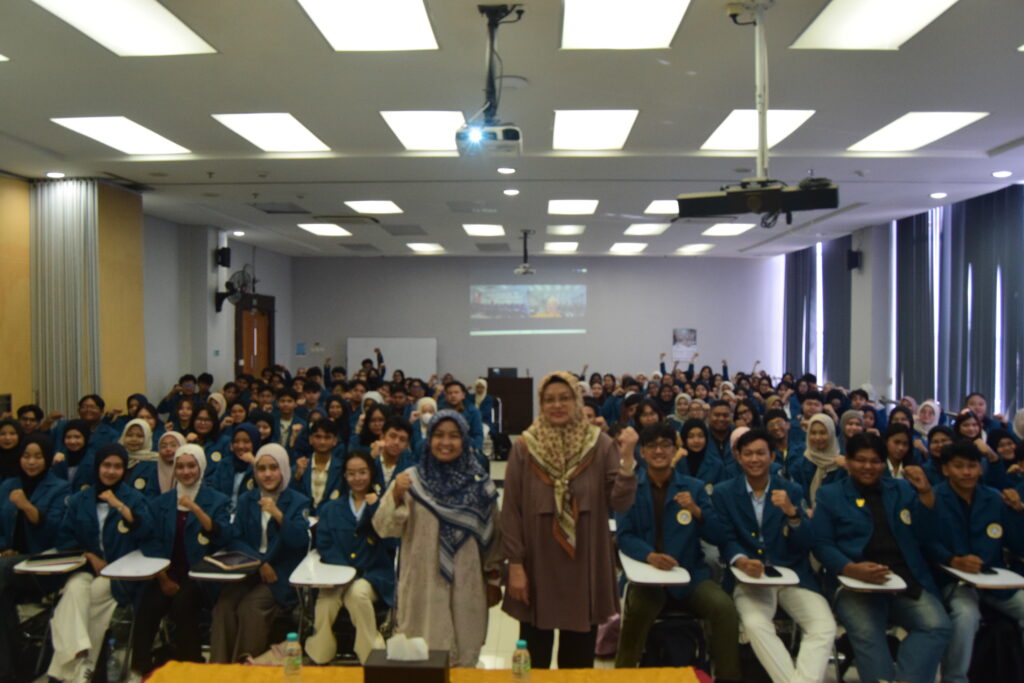
Faculty of Fisheries and Marine Sciences, Universitas Airlangga (FPK UNAIR) officially commenced the first day of the Basic Student Management Skills Training (LKMM-TD) 2026 on Saturday, June 6, 2026. The annual leadership development program took place on the 5th and 6th floors of Building C, Faculty of Fisheries and Marine Sciences, MERR-C Campus, Surabaya. Bringing together 270 active students, the program serves as a strategic platform to strengthen organizational management competencies, leadership values, and professional skills essential for future student leaders in higher education.
Strengthening Organizational Awareness Through Environmental Analysis and Idea Formulation
The opening ceremony began at 07:30 AM WIB with participant registration, followed by a formal session featuring the singing of the Indonesian national anthem, Indonesia Raya, and the Airlangga Hymn. The event was officially inaugurated through welcoming remarks from the faculty leadership, who emphasized the importance of adaptive and responsible student leadership in addressing contemporary challenges within academic and organizational environments.
As one of the flagship student development programs at FPK UNAIR, LKMM-TD aims to equip participants with a comprehensive understanding of organizational management fundamentals. The first day focused on building participants’ analytical thinking and strategic planning capabilities through a series of structured managerial training sessions delivered by experienced lecturers and academic experts.
The first session, titled Environmental Condition Analysis, was presented by Luthfiana Aprilianita Sari, S.Pi., M.Si. During this session, participants learned systematic approaches to identifying strengths, weaknesses, opportunities, and challenges surrounding organizations within the fisheries and marine sectors. The training encouraged students to understand external and internal organizational dynamics before formulating strategic initiatives and work programs.
Following this session, Muhammad Browijoyo Santanumurti, S.Pi., M.Sc., Ph.D. delivered the second material, Formulation and Elaboration of Initial Ideas. Through interactive discussions and practical examples, participants were guided to transform environmental analysis results into innovative, creative, and feasible organizational programs. The session highlighted the importance of evidence-based planning and critical thinking in developing impactful student initiatives that contribute positively to the academic community and society.
Developing Organizational Management Competencies Through Structured Planning
After a short break, the program continued with the third session, Fundamentals of Organization, presented by Terry Previo Avianto, M.Si. This material introduced participants to essential organizational concepts, including bureaucratic structures, division of responsibilities, coordination mechanisms, and administrative management. Students were encouraged to understand how effective organizational systems support productivity, accountability, and sustainable leadership practices.
The session also emphasized the significance of organizational governance in maintaining efficiency and transparency within student organizations. Through case-based discussions, participants gained practical insights into managing organizational resources and fostering collaborative working environments. Such competencies are considered fundamental for students who will later assume leadership roles in faculty-based organizations, committees, and community engagement programs.
The fourth session, Work Schedule Planning, was delivered by Putri Desi Wulan Sari, S.Pi., M.Si. Participants were trained to develop effective work timelines using matrix-based planning methods. The material focused on project scheduling, priority management, task allocation, and deadline monitoring to ensure organizational activities can be implemented systematically and efficiently.
In addition, students learned various time-management strategies aimed at preventing overlapping agendas and improving committee performance. Through simulation exercises, participants practiced designing realistic and measurable work plans that align with organizational objectives. These competencies are expected to enhance students’ ability to manage academic responsibilities while actively contributing to organizational and extracurricular activities.
Equipping Future Leaders with Performance Evaluation and Conflict Management Skills
Following the midday break for prayer and lunch, participants returned to a dynamic learning environment for the fifth session, Success Indicators and Performance Measurement, delivered by Dr. Rozi, S.Pi., M.Biotech. This session focused on developing participants’ ability to establish clear quantitative and qualitative benchmarks for organizational programs. Students learned how measurable objectives can support program evaluation, accountability, and continuous improvement.
The material also introduced participants to performance assessment techniques commonly used in project management and organizational development. By understanding the importance of measurable outcomes, students can design programs that generate tangible impacts while maintaining alignment with organizational visions and goals.
The final session of the day featured Conflict Management, presented by Annur Ahadi Abdillah, S.Pi., M.Si., Ph.D. This session equipped participants with practical approaches to handling interpersonal conflicts, facilitating communication, conducting mediation, and managing stress in organizational settings. Through various case studies and interactive discussions, students explored strategies for maintaining constructive relationships and fostering teamwork despite differences in perspectives and opinions.
The first day of LKMM-TD 2026 concluded officially at 03:15 PM WIB and was formally closed by representatives of the student organizing committee. Through its commitment to developing leadership capacity and strengthening institutional collaboration, the program contributes to the achievement of Sustainable Development Goal (SDG) 4 on Quality Education and SDG 17 on Partnerships for the Goals. Through initiatives such as LKMM-TD, FPK UNAIR continues to support the development of competent, innovative, and integrity-driven student leaders who are prepared to contribute to the advancement of fisheries, marine sciences, and sustainable community development. Further information regarding research initiatives, academic programs, and institutional activities can be accessed through the official website of the Faculty of Fisheries and Marine Sciences, Universitas Airlangga.
Writer : Reyfan Dwi Ananta
Editor : TPA