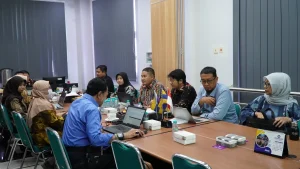
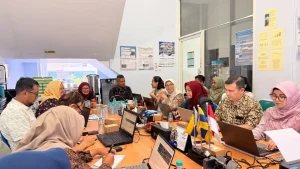
SURABAYA – The Faculty of Fisheries and Marine (FPK) Universitas Airlangga (UNAIR) continues to strengthen international learning for its students. On Monday (24/8/2026), FPK UNAIR welcomed academics from Universiti Teknologi MARA (UiTM) and Universiti Kebangsaan Malaysia (UKM) for an international guest lecture.
The session featured Dr. Sharifah Raina binti Manaf, Senior Lecturer at the Faculty of Plantation and Agrotechnology, UiTM Mukah Campus, Sarawak, Malaysia. She shared her expertise with first-year students from the Aquaculture Study Program at FPK UNAIR.
The lecture focused on “Biosecurity Strategies for Preventing Disease Outbreaks in Intensive Aquaculture.” Through the topic, students explored strategies that aquaculture practitioners can apply to prevent disease outbreaks in intensive farming systems.
Understanding the Importance of Biosecurity

During the lecture, Dr. Sharifah Raina explained how biosecurity helps aquaculture practitioners maintain the health of cultured organisms. She emphasized the need to prioritize prevention before diseases develop into outbreaks.
Additionally, students explored several key biosecurity measures. These measures include managing water quality, controlling the movement of organisms and people, maintaining equipment sanitation, and monitoring organism health.
Furthermore, Dr. Sharifah Raina highlighted early detection as an essential part of disease prevention. Therefore, aquaculture practitioners should regularly observe cultured organisms. Regular monitoring helps them identify disease symptoms early and respond to potential problems quickly.
Learning the Five Golden Rules of Biosecurity
The session then moved into an interactive discussion and question-and-answer session. During the discussion, Samir, a first-year Aquaculture student, asked what farmers should do when new fry arrive at an aquaculture facility.
In response, Dr. Sharifah Raina explained the Five Golden Rules of Biosecurity: Know, Separate, Control, Detect, and Act.
First, Know means identifying the fry’s origin and health condition. Next, Separate requires farmers to keep new fry away from existing stocks. Meanwhile, Control focuses on managing water, personnel, and equipment.
Furthermore, Detect encourages farmers to monitor organism health regularly. Finally, Act requires farmers to respond quickly when they find signs of disease. Together, these five principles can help aquaculture practitioners reduce the risk of disease introduction and spread.
“If newly arrived fry reach the farm, we first need to know their origin and health condition. We should not immediately mix them with the existing stock. Instead, we should isolate and monitor them first so that we can detect potential disease risks early,” explained Dr. Sharifah Raina.
Through this activity, students gained practical insights into biosecurity and experienced an international academic learning environment. Moreover, the activity supports SDG 4 (Quality Education) by promoting knowledge exchange and academic interaction across countries.
Meanwhile, the collaboration between FPK UNAIR, UiTM, and UKM supports SDG 17 (Partnerships for the Goals). Through this partnership, the three institutions can strengthen their networks in education, research, and the development of fisheries and marine sciences.
Writer: Alejandro Ahmad Zuhayr
Editor: TPA