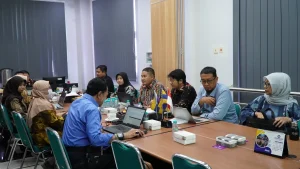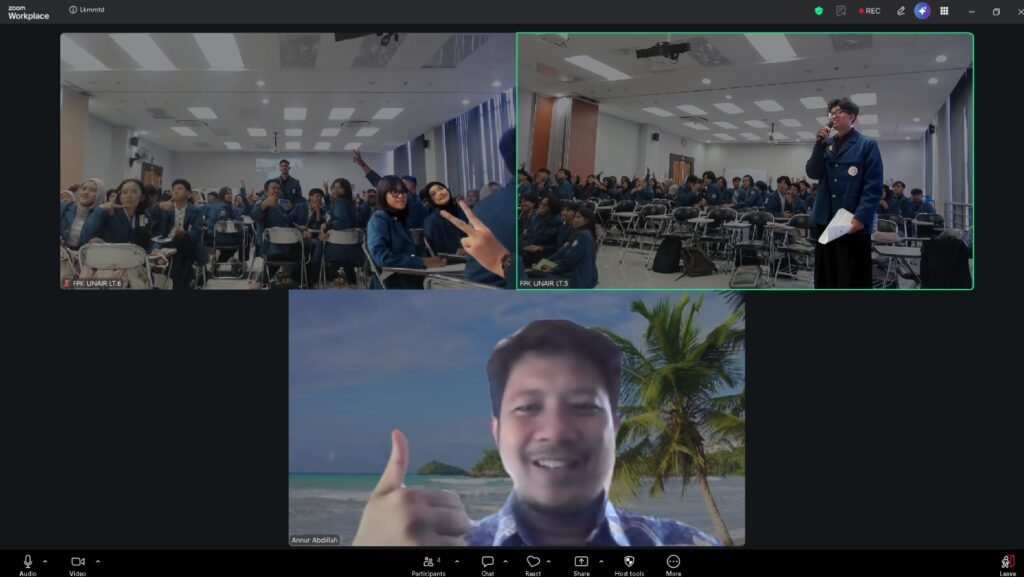
SURABAYA – Conflict is often perceived as something that should be avoided within organizations. However, behind differences in opinions, interests, and perspectives, conflict is actually a natural part of group dynamics. This understanding became the central focus of the Conflict Management session delivered by Annur Ahadi Abdillah, S.Pi., M.Si., Ph.D., during the 2026 Basic Student Management Skills Training (Latihan Keterampilan Manajemen Mahasiswa Tingkat Dasar – LKMM-TD) organized by the Faculty of Fisheries and Marine Sciences, Universitas Airlangga (FPK UNAIR).
The session introduced students to the fundamental concepts of conflict, various forms of conflict that may arise within organizations, the underlying causes of conflict, and the importance of decision-making in conflict resolution processes. As future leaders and active members of student organizations, participants were encouraged to view conflict not merely as a challenge but as an opportunity for organizational growth and improvement. Through this training, students gained practical insights into managing interpersonal relationships, strengthening teamwork, and fostering a productive organizational environment.
In his presentation, Annur Ahadi explained that conflict can be understood as a dispute, disagreement, or opposition that emerges due to differences in interests and goals among individuals or groups. He also introduced several scholarly perspectives on conflict. Daniel Webber defines conflict as a condition in which competing or incompatible alternatives exist, while Stephen Robbins describes conflict as an effort by one party to counterbalance another through actions that may influence the achievement of the other party’s objectives. These perspectives illustrate that conflict is an inherent aspect of human interaction and organizational life.
Participants were further introduced to three major perspectives on conflict. The traditional perspective considers conflict detrimental and believes it should be avoided because it may disrupt organizational stability. In contrast, the human relations perspective views conflict as a natural and unavoidable phenomenon within groups. Meanwhile, the interactionist perspective regards conflict as a positive force capable of stimulating innovation, encouraging creativity, and driving organizational development. According to Annur Ahadi, understanding these perspectives is essential for students, as it enables them to recognize that conflict does not always signify organizational failure. Under certain circumstances, conflict can serve as a valuable mechanism for evaluation and continuous improvement.
Exploring Types of Conflict and Effective Team Dynamics
Beyond discussing theoretical concepts, the session also explored various types of conflict commonly encountered in daily life and organizational settings. Personal conflict refers to emotional tension experienced by individuals when facing difficult choices or situations. Interpersonal conflict arises from differences in viewpoints, personalities, or interests between individuals. Meanwhile, intra-group conflict occurs when disagreements emerge among members within a team or organization working toward shared objectives.
To provide a broader understanding of organizational dynamics, Annur Ahadi emphasized the importance of effective work groups. He explained that a work group consists of individuals brought together to perform organizational tasks and achieve predetermined goals. Because work groups are composed of members with diverse backgrounds, experiences, and personalities, the emergence of conflict is often inevitable. Rather than attempting to eliminate conflict entirely, organizations should focus on managing it effectively to maintain productivity and cohesion.
Conflict within work groups can take many forms. It may occur among members within the same organizational unit, between members and leaders in a division, among members from different divisions, or even between organizational leaders with distinct responsibilities. These various forms of conflict demonstrate the importance of communication, collaboration, and mutual understanding in maintaining healthy organizational relationships. Students were encouraged to develop interpersonal skills that would enable them to navigate organizational challenges constructively.
The discussion also highlighted the role of leadership in managing conflict. Effective leaders are expected to recognize early signs of disagreement, facilitate open communication, and encourage collaborative problem-solving. By understanding the dynamics of conflict within teams, students can better prepare themselves to assume leadership roles in student organizations and future professional environments. The session reinforced the idea that organizational success depends not on the absence of conflict, but on the ability of individuals to address differences in a constructive and solution-oriented manner.
Identifying Conflict Sources and Developing Leadership Competencies
One of the topics that attracted significant attention from participants was the discussion on the sources of conflict within organizations. Annur Ahadi explained that four primary factors commonly contribute to the emergence of conflict. The first factor is communication. Misunderstandings, insufficient information, and ineffective message delivery frequently become major triggers of disputes among organizational members. Poor communication can create confusion and misinterpretation, ultimately affecting teamwork and organizational performance.
The second factor involves task structures and organizational structures. Unclear job descriptions, overlapping responsibilities, and inadequate coordination may create tensions during the implementation of organizational programs and activities. The third factor is personal characteristics, including values, attitudes, personalities, and individual behavioral tendencies. Since every person brings unique experiences and perspectives into an organization, differences can sometimes lead to disagreements. The final factor is the organizational environment, which may influence workplace conditions, interpersonal relationships, and overall organizational culture.
By understanding these sources of conflict, participants were encouraged to identify potential issues at an early stage and implement appropriate preventive or corrective measures. Such competencies are essential elements of leadership and organizational management. Annur Ahadi emphasized that conflict is a natural phenomenon that cannot be completely avoided. Therefore, the primary objective of organizations should not be to eliminate conflict but to manage it constructively. Well-managed conflict can become a source of learning, evaluation, and improvement that contributes to organizational development.
During the session, Annur Ahadi underscored the importance of embracing conflict as a normal aspect of human interaction. “Humanizing conflict is wiser than denying its existence,” he remarked, highlighting the need for individuals to acknowledge and address differences openly. Participants expressed that the session provided a fresh perspective on handling disagreements within organizations. Rather than viewing conflict as a threat, they learned to see it as an opportunity to improve communication, strengthen teamwork, and enhance organizational effectiveness.
Through the Conflict Management session, LKMM-TD 2026 FPK UNAIR not only provided students with a deeper understanding of organizational dynamics but also strengthened their critical thinking, communication, and decision-making skills. The activity supports the achievement of Sustainable Development Goal (SDG) 4: Quality Education by enhancing student leadership and management competencies. Furthermore, it contributes to SDG 17: Partnerships for the Goals by equipping participants with the ability to build collaboration, resolve differences constructively, and strengthen synergy within student organizations and future professional networks.
Author: Alejandro Ahmad Zuhayr
Editor: TPA