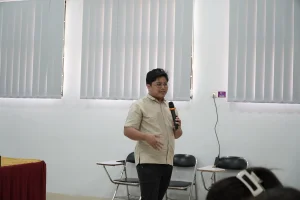
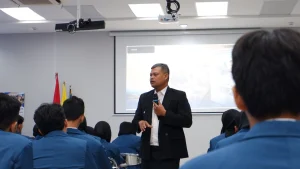
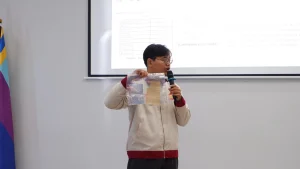
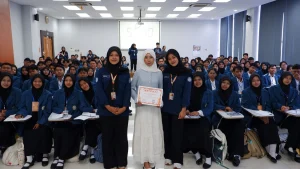
Surabaya – Effective communication is one of the fundamental competencies that students need to develop in order to succeed in organizational and leadership activities. Through the Basic Student Management Skills Training (LKMM-TD) 2026 organized by the Faculty of Fisheries and Marine Sciences (FPK), Universitas Airlangga, participants received valuable insights into the importance of organizational communication during a session entitled “Communication in Organizations,” delivered by Daruti Dinda Nindarwi, S.Pi., M.P., on Sunday (June 7, 2026).
The session was designed to enhance students’ understanding of how communication contributes to organizational effectiveness and sustainability. In her presentation, Daruti explained that organizational communication is a process of creating, delivering, interpreting, and exchanging messages among communication units within an organization to achieve common goals. Communication, therefore, extends beyond simply transmitting information; it also involves interpreting messages, fostering mutual understanding, and maintaining continuous interactions among members.
According to Daruti, every organization consists of individuals connected through a structured system of relationships and responsibilities. Consequently, the success of an organization is strongly influenced by the quality of communication established among its members. She introduced participants to two primary forms of organizational communication: vertical communication and horizontal communication.
Vertical communication occurs between leaders and members through a two-way communication process. This form of communication plays a critical role in conveying instructions, reporting progress, conducting evaluations, and providing feedback within an organization. Meanwhile, horizontal communication takes place among individuals who hold similar positions or responsibilities, such as between staff members or departments. This communication pattern helps strengthen coordination, collaboration, and teamwork in implementing organizational programs and activities.
In addition to internal communication, participants were also introduced to the concept of external communication, which plays a significant role in shaping an organization’s public image and reputation. External communication can be conducted through various channels, including press releases, articles, speeches, brochures, posters, and press conferences. Through these communication tools, organizations can effectively disseminate information and engage with broader audiences in a professional manner.
During the interactive session, participants explored several common barriers to organizational communication. These barriers include technical barriers, semantic barriers, and human-related barriers. Technical barriers may arise from inadequate communication facilities, limited access to information, or inappropriate communication channels. Semantic barriers occur when individuals interpret the same message differently due to variations in language, terminology, or understanding. Meanwhile, human barriers often stem from emotions, personal perceptions, prejudices, and individual limitations in receiving or processing information.
“Communication is not merely about delivering a message, but ensuring that the message is clearly understood by all parties involved. Organizations that can establish effective communication are better prepared to overcome challenges and achieve their collective goals,” Daruti emphasized during the session.
Beyond theoretical concepts, the training also provided students with practical communication skills that can be applied in various organizational settings. Participants were encouraged to develop the ability to convey ideas clearly, practice active listening, and understand communication flows within organizations. These competencies are expected to improve coordination among student organizations, committees, and collaborative projects.
Understanding vertical, horizontal, and external communication serves as an essential foundation for future leadership roles. Effective communication can minimize misunderstandings, overlapping responsibilities, and internal conflicts while promoting transparency, efficiency, and alignment toward organizational objectives. Furthermore, communication skills are among the most sought-after competencies in professional environments, where graduates are expected to interact effectively with colleagues, academics, government agencies, industry partners, and wider communities.
Through this training session, LKMM-TD 2026 seeks to cultivate students who are not only active organizational members but also effective, adaptive, and ethical communicators capable of addressing future challenges. These competencies will serve as valuable assets in fostering productive student organizations and contributing positively to academic communities and society at large.
This activity also supports the implementation of the Sustainable Development Goals (SDGs), particularly SDG 4 (Quality Education) through the enhancement of students’ communication and leadership competencies, and SDG 17 (Partnerships for the Goals) by strengthening collaboration, coordination, and partnership-building skills among future leaders.
Writer : Farrel Bhanu Mahardhika
Editor: TPA