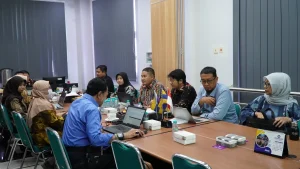
Students of the Faculty of Fisheries and Marine Sciences, Universitas Airlangga (FPK UNAIR), gained international academic exposure through a guest lecture session focusing on innovation in fisheries product development, delivered by an academic from Universiti Malaysia Terengganu.
The Faculty of Fisheries and Marine Sciences at Universitas Airlangga (FPK UNAIR) continued its commitment to expanding global academic insight by hosting an International Guest Lecture Session as part of the Fundamentals of Fisheries Product Processing course. The activity was attended by second-semester students from the Aquaculture and Fishery Product Technology study programs. Held online on Tuesday, June 9, 2026, the session was designed to broaden students’ understanding of current trends and innovations in seafood-based product development within the global fisheries industry.
The lecture featured Dr. Nabilah Binti Abdul Hadi from the Faculty of Food Science and Agrotechnology, Universiti Malaysia Terengganu (UMT), who presented a topic titled “From Sea to Shelf: Innovation in Fisheries and Seafood-Based Products.” The session highlighted the growing importance of integrating scientific innovation with fisheries processing to create value-added products that are not only competitive in the global market but also aligned with sustainability principles. Through this international academic engagement, students were introduced to cutting-edge research developments that connect marine resource utilization with food technology advancements, emphasizing how fisheries products can be transformed into high-value functional foods.
During her presentation, Dr. Nabilah introduced the Faculty of Food Science and Agrotechnology (FSMA) at UMT, including its academic programs and key research directions. She explained that ongoing studies in food science and agrotechnology focus heavily on sustainability, food security, and optimizing marine resource utilization. One of the key learning points discussed was the application of chitosan as a functional ingredient in innovative food product development. Chitosan, derived from marine resources, has shown significant potential in improving product texture, stability, and functionality, making it a promising material in the advancement of seafood-based innovations.
Furthermore, the speaker elaborated on modern food engineering technologies such as Pickering emulsions and complex emulsions, which are increasingly utilized in the food industry to enhance the stability and delivery of bioactive compounds. These technologies allow nutrients to be preserved and released more effectively during digestion, thereby improving the nutritional value of food products. An example highlighted during the lecture was the application of emulsion technology to enhance the stability and bioaccessibility of Vitamin D3 in fortified seafood products, demonstrating how scientific innovation can directly improve both product quality and consumer health outcomes.
The session was highly interactive, with students actively engaging in discussions and asking questions related to the practical implementation of advanced food technologies in the fisheries industry. The enthusiasm shown by participants reflected a strong interest in research-driven innovation and its real-world applications. According to Dr. Nabilah, academic collaborations such as guest lectures play a crucial role in bridging knowledge between institutions and preparing students to face the challenges of a rapidly evolving global food industry.
This international guest lecture reflects the strong commitment of FPK UNAIR to strengthening global academic collaboration and improving educational quality through knowledge exchange with international institutions. In line with Sustainable Development Goals (SDGs) 17: Partnerships for the Goals, this initiative serves as a tangible example of how cross-border academic cooperation can enhance education, research, and innovation in the fisheries and marine science sector.