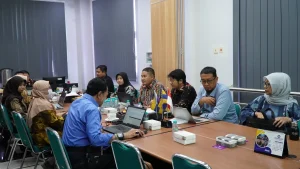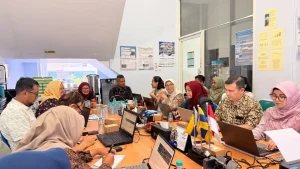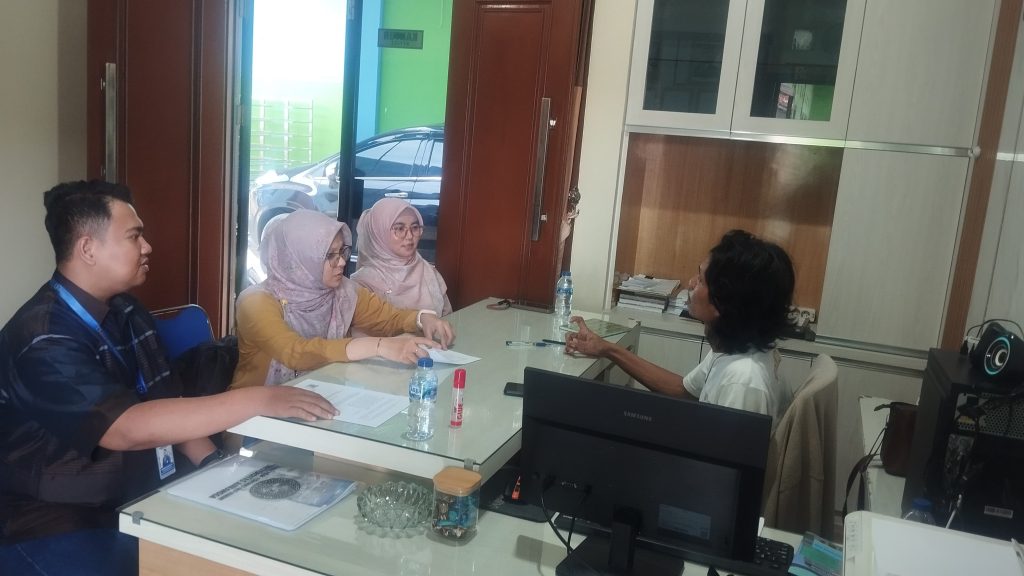
Surabaya, August 30, 2025 — The Fieldwork Practice Program (PKL) serves as an integral component of the academic requirements for all students of the Faculty of Fisheries and Marine Sciences, Universitas Airlangga (FPK UNAIR), encompassing both the Aquaculture and Fishery Products Technology study programs. To ensure the program’s quality and alignment with learning outcomes, the faculty conducted a Monitoring and Evaluation (Monev) visit to several fieldwork locations. The purpose of this visit was to observe student activities on-site, assess the suitability of the internship locations, and gather feedback from partner institutions regarding student performance and collaboration potential.
This monitoring initiative also aimed to initiate formal institutional partnerships between FPK UNAIR and industry stakeholders through draft cooperation agreements. These agreements are expected to support the Merdeka Belajar Kampus Merdeka (MBKM) program by expanding opportunities for students to engage in industrial learning environments that integrate academic knowledge with practical experience.
The monitoring and evaluation visits were conducted over two days, from August 27 to 28, 2025, by a team consisting of Dr. Ayu Lana Nafisyah, S.Pi., M.Sc., Ph.D. (Department of Aquaculture), Dwitha Nirmala, S.Pi., M.Si. (Department of Marine Science), and academic staff members Ahmad Jamil Abdunnasir, S.Pi. and Muchammad Wachyu Ramadhan. The field visits covered three key locations in Central Java: CV Putra Mandiri Jaya Rembang, PT Dua Putra Utama Makmur Pati, and the Brackishwater Aquaculture Development Center (BBPBAP) Jepara.
During the evaluation, industrial partners expressed positive impressions of FPK UNAIR students’ technical competencies, particularly those undertaking internships at frozen seafood companies. Their strong understanding of processing technology, hygiene standards, and quality control was commended as aligning well with industry expectations. In an effort to strengthen these partnerships, the FPK UNAIR team presented draft cooperation agreements (PKS) to each partner organization. The documents formalized the faculty’s commitment to long-term collaboration in research, education, and professional development. Several partners also expressed interest in extending the cooperation to postgraduate student research and joint innovation projects in fisheries product development.
At BBPBAP Jepara, the evaluators noted that while students demonstrated strong academic knowledge, there remains room for improvement in soft skills, particularly in communication, leadership, and critical thinking. This observation highlights the importance of integrating soft skill enhancement into the PKL curriculum, ensuring students are well-prepared not only technically but also in interpersonal and problem-solving competencies required in professional environments.
Beyond serving as a technical evaluation, this monitoring program provided strategic insights for enhancing graduate quality and strengthening academic-industry linkages. FPK UNAIR remains committed to developing an education system that is relevant, adaptive, and impactful, fostering future professionals who can contribute to sustainable development in the fisheries and marine sector. Through continuous evaluation and partnership building, the faculty aims to improve the quality of PKL programs and expand access to high-quality, relevant internship opportunities for all FPK UNAIR students in the coming years.