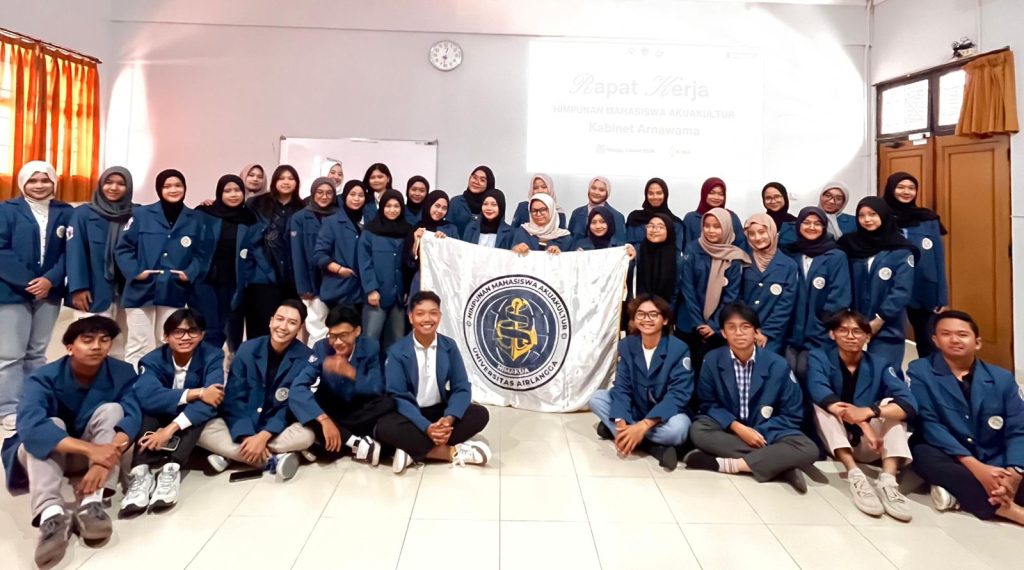
The Aquaculture Student Association (HIMAKUA) for the 2026 period under the Arnawama Cabinet successfully held its Annual Work Meeting on March 1, 2026, at Room B 3.04, Faculty of Fisheries and Marine Sciences, Universitas Airlangga. The meeting aimed to formulate and discuss the work programs of each department that will be implemented throughout the upcoming organizational period. Through this forum, the organization sought to design structured and measurable programs complete with clear objectives, timelines, persons in charge (PIC), budgeting plans, and indicators of success aligned with HIMAKUA’s 2026 vision and mission.
The Work Meeting proceeded smoothly and in a conducive atmosphere. All HIMAKUA staff actively participated by sharing ideas, offering suggestions, and engaging in discussions regarding the implementation of programs for the upcoming period. Beyond its function as a strategic forum to formulate and finalize organizational programs, the meeting also served as a moment of bonding among members of the board. Through this activity, the committee hopes to strengthen communication, encourage active participation, and foster collaboration among all administrators in carrying out the organization’s agenda throughout the year.
In this period, HIMAKUA under the Arnawama Cabinet introduced several new flagship programs designed not only to enhance organizational performance but also to strengthen the branding of the association, the Aquaculture study program, and the Faculty of Fisheries and Marine Sciences. One of the newly introduced initiatives is “AQUABISA” (Akuakultur Bina Desa), a community service program based on aquaculture practices. The program focuses on providing education and hands-on aquaculture training for rural communities with the aim of improving human resource capacity and supporting local economic potential through sustainable aquaculture activities.
Through AQUABISA, students are encouraged to apply the knowledge and skills they gain during their academic studies directly within the community. The program is expected to produce tangible outcomes, including the development of students’ soft skills such as communication, teamwork, and problem-solving, while simultaneously empowering rural communities through aquaculture-based economic activities. This initiative reflects HIMAKUA Arnawama Cabinet’s vision to create broader impact—not only for university students but also for society at large.
Furthermore, the AQUABISA program aligns with the principles of the Blue Economy and contributes to the achievement of several Sustainable Development Goals (SDGs). In particular, the initiative supports SDG 2 (Zero Hunger) by promoting food security, improving nutrition, and strengthening sustainable aquaculture practices. At the same time, the program contributes to SDG 14 (Life Below Water) by emphasizing responsible management of aquatic resources and the preservation of aquatic ecosystems. Through collaborative and community-based initiatives such as AQUABISA, HIMAKUA aims to demonstrate how academic knowledge in aquaculture can contribute to sustainable development and community empowerment in line with the Blue Economy 2030 agenda.