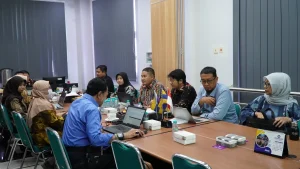
Surabaya – The second day of the 2026 Basic Student Management Skills Training (LKMM-TD) organized by the Faculty of Fisheries and Marine Sciences (FPK), Universitas Airlangga (UNAIR), continued with a session aimed at strengthening students’ organizational competencies. On Sunday (June 7, 2026), participants received training on activity proposal refinement delivered by Dr. nat. techn. Muhamad Nur Ghoyatul Amin, S.TP., M.P., M.Sc.
This session served as a continuation of the previous training on activity proposal development. While the earlier session focused on equipping students with the fundamental skills required to prepare activity proposals, this follow-up session emphasized the importance of evaluating, revising, and refining proposals to ensure that planned programs are realistic, effective, and capable of generating meaningful impact.
During the session, Dr. Muhamad Nur Ghoyatul Amin explained that an activity proposal should never be considered complete simply because it has been written. Instead, proposal development should be viewed as an ongoing process that requires critical review and continuous improvement. According to him, refinement is essential to ensure that proposed programs effectively address organizational needs and achieve their intended objectives.
“A good proposal is not one that is merely completed, but one that is continuously improved through evaluation and refinement to address organizational needs and create meaningful impact,” he explained.
Participants were introduced to several important aspects that should be carefully reviewed during the proposal refinement process, including the clarity of the background, the relevance of objectives, the suitability of success indicators, the effectiveness of implementation methods, and the feasibility of the proposed budget. He emphasized that even minor weaknesses in a proposal can significantly affect the quality of program implementation if they are not addressed during the planning stage.
One of the key messages highlighted during the session was the importance of critical thinking in program planning. Students were encouraged not only to focus on the execution of activities but also to consider long-term impacts, program sustainability, and the benefits that can be generated for participants and the broader community. This perspective is increasingly important in ensuring that student-led initiatives contribute meaningfully to organizational development and social impact.
Through various case studies and examples of student activity proposals, participants were invited to analyze the strengths and weaknesses of different proposals. This practical approach provided valuable learning experiences and enabled students to understand how proposal refinement is conducted before a program receives approval and proceeds to implementation.
The interactive discussions throughout the session reflected the participants’ enthusiasm for gaining a deeper understanding of program planning and evaluation. Questions focused on determining appropriate success indicators, preparing realistic budgets, and designing programs capable of delivering sustainable outcomes. These discussions demonstrated students’ growing awareness of the importance of strategic planning and evidence-based decision-making within student organizations.
The Activity Proposal Refinement session plays an important role in fostering a more systematic and solution-oriented mindset among students. The ability to critically evaluate work plans and identify areas for improvement is a valuable competency that will support students in organizational leadership, project management, and future professional environments.
This activity aligns with FPK UNAIR’s commitment to supporting the Sustainable Development Goals (SDGs), particularly SDG 4 (Quality Education) through the enhancement of students’ managerial and leadership competencies. Furthermore, the ability to design and evaluate programs effectively contributes to SDG 16 (Peace, Justice and Strong Institutions) by promoting accountable organizational governance and evidence-based planning. At the same time, the development of impactful and sustainable programs supports SDG 17 (Partnerships for the Goals) by strengthening collaboration and improving the quality of student-led initiatives.
Through this training, LKMM-TD 2026 participants are expected not only to develop strong activity proposals but also to cultivate the ability to critically evaluate and continuously improve them. As a result, future programs can become more measurable, effective, and impactful, contributing positively to both organizational development and the wider community.
Author : Farrel Bhanu Mahardhika
Editor : TPA