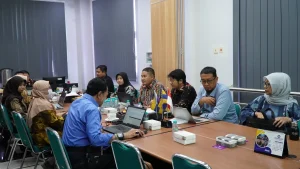
Surabaya – The ability to effectively manage organizations and committees is an essential competency for students in supporting the successful implementation of programs and activities. Through the Basic Student Management Skills Training (LKMM-TD) 2026, the Faculty of Fisheries and Marine Sciences (FPK), Universitas Airlangga, provided participants with valuable insights through a session entitled “Activity and Committee Organization,” delivered by Syifania Hanifah Samara, S.Pi., M.Sc.
The session aimed to strengthen students’ understanding of organizational management principles and their application in student organizations and event committees. In her presentation, Syifania explained that organizing is the process of designing an organizational structure, allocating responsibilities, and establishing working relationships among members to ensure that organizational goals can be achieved effectively and efficiently.
She emphasized that the success of an organization is influenced by several factors, including organizational strategy, technological support, human resources, and the scale of the organization itself. As a result, every organization requires a clear and well-defined structure so that each individual understands their responsibilities, authority, and role within the organization.
Participants were introduced to various key elements of organizational management, including job specialization, activity standardization, coordination among work units, and decision-making systems that may be centralized or decentralized. Understanding these elements is crucial in developing organizational systems that can operate efficiently while maintaining flexibility in responding to challenges and opportunities.
The discussion also covered the concept of departmentalization, which refers to the grouping of organizational activities based on functions, products, geographic regions, services, or specific work processes. This concept serves as an important foundation for designing effective committee structures and ensuring that tasks are distributed appropriately among members.
“A successful organization is not built solely by talented individuals, but by a clear system, appropriate task allocation, and consistent coordination among its members,” Syifania explained during the session.
Beyond organizational structures, participants were encouraged to understand both the advantages and challenges associated with organizational management. On one hand, a well-structured organization can foster creativity, increase productivity, improve coordination, and enhance the quality of decision-making. On the other hand, organizations may also face challenges such as internal conflicts, lengthy bureaucratic processes, and interdependence among divisions that can affect efficiency if not managed properly.
The interactive discussion enabled students to explore real-life organizational situations commonly encountered in student associations and event committees. Through practical examples and case-based learning, participants gained a deeper understanding of how organizational structures influence communication, teamwork, and program implementation.
The session also highlighted the importance of professional attitudes in committee management. Effective committee members are expected to demonstrate responsibility, discipline, accountability, and strong collaborative skills. By applying sound organizational principles, student committees can develop programs that are more organized, impactful, and beneficial to both the university community and society.
For university students, organizational experiences serve as valuable preparation for future professional careers. The ability to coordinate teams, manage responsibilities, solve organizational challenges, and collaborate with diverse stakeholders represents a set of transferable skills that are highly valued in modern workplaces. Therefore, strengthening organizational and managerial competencies through LKMM-TD is considered an important investment in student development.
This training reflects FPK UNAIR’s commitment to supporting the Sustainable Development Goals (SDGs), particularly SDG 4 (Quality Education) through the enhancement of students’ managerial and leadership capacities. Furthermore, the development of organizational coordination and collaborative competencies aligns with SDG 17 (Partnerships for the Goals) by fostering effective teamwork, communication, and partnership-building skills among future leaders.
Through this session, LKMM-TD 2026 participants are expected to develop a comprehensive understanding of organizational management and committee administration. By mastering these skills, students will be better prepared to lead organizations, manage projects, and contribute positively to academic institutions and broader communities.
Author : Farrel Bhanu Mahardhika
Editor : TPA